‏إظهار الرسائل ذات التسميات British Pound. إظهار كافة الرسائل

السبت، 2 أبريل 2011

British Pound: It’s All Relative

Since the inception of the credit crisis, perhaps no currency has been beaten down more than the British Pound, with analysts bitterly divided about whether the currency will fall further. A lot depends on whether the British efforts to save its devastated banking sector are successful. The government has already moved to nationalize the Bank of Scotland, and is quickly moving to shore up the capital positions of other vulnerable banks. Experts point to the Pound's historic volatility, however, as an indication that investors have always fled, and will continue to flee the UK in times of uncertainty. Jim Rogers, whose partner George Soros famously "broke" the Bank of England in 1992, forecasts a bleak future, although his motives are questionable. Ultimately, the fate of the Pound is entirely relative, as is the case with all currencies. In other words, if investors suddenly changed their minds about the perceived stability of the Dollar and Yen, the Pound could quickly recover. Business Week reports:
As investors begin to renew their focus on the problems of other economies, the pressure on sterling may ease. The selling could turn to buying if investors suddenly decide they'd rather take a little risk to earn return, rather than watching their cash evaporate.

UK, EU Central Banks Follow the Federal Reserve

Yesterday, both the European Central Bank (ECB) and the Bank of the UK cut their benchmark interest rates to record lows. This is especially incredible in the case of the UK, whose Central Bank over 300 years old! You can see from the following chart that both Central Banks have more than made up for their respectively slow starts in easing monetary policy by effecting several dramatic rate cuts, following the example of the Federal Reserve. The baseline UK rate now stands at .5%, only slightly higher than the Federal Funds rate, and slightly lower than the 1.5% ECB rate.

Given that they have essentially reached the terminus of their monetary policy options, all three Central Banks are exploring further options aimed at pumping money into their respective economies. The Fed has already “announced a program to buy $100 billion in the direct obligations of housing related government sponsored enterprises (GSEs) — Fannie Mae, Freddie Mac and the Federal Home Loan banks — and $500 billion in mortgage-based securities backed by Fannie Mae, Freddie Mac and Ginnie Mae.” As I wrote in a related article, “this was quickly followed by repurchase programs, lending facilities, investments in money market funds, and option agreements, all of which were designed to supplement its ‘traditional open market operations and securities lending to primary dealers.’ The Fed’s efforts also worked to ease the liquidity shortage in credit markets abroad by entering into swap agreements with several foreign Central Banks suffering from acute Dollar shortages.”
In conjunction with the rate cut, the Bank of the UK, meanwhile, will pump £150bn directly into UK credit markets through liquidity support, buying public and private debt, and asset purchases. “The main purpose of quantitative easing is not to send the money supply into orbit but to stop it from crashing…the broad money held by households has risen at a worryingly slow rate over the past year, and holdings by private non-financial firms have actually been dropping.” In contrast to the monetary programs of the UK and US, the ECB has thus far refrained from the kind of liquidity support that would necessitate printing new money. Instead, “the central bank will continue offering euro-zone banks unlimited loans at the central bank’s policy rate until at least the end of this year.”
The interest rate cuts were announced simultaneously with a spate of macroeconomic data, which collectively paint a bleak picture. Eurozone growth is projected at -2.7% for 2009 and 0% for 2010. The current unemployment rate at 8.2% and climbing. The thorn in the side of the EU is represented by eastern Europe, where growth is falling at an alarming pace, dragging the EU down with it. While EU member states have pledged to intervene if one of their own falls into bankruptcy, it’s unlikely that they would intervene similarly if a non-EU member state went bust. The UK economy is similarly desperate, having contracted at an annualized rate of 5.8% in the most recent quarter. The wild cards are the real estate and financial sectors, the fortunes of which are increasingly intertwined.
So what do the forex markets have to say about all this? Economists have used the dual phenomena of risk aversion and deflation to explain the interminable weakness in the the Pound and Euro. Everyone is surely familiar with the notion of the US as “safe haven” during periods of global financial instability. The deflation hypothesis, meanwhile, suggests that the ECB (and to a lesser extent, the Bank of UK), fell behind the curve when easing liquidity. The ECB, especially has harped on inflation as a reason for cutting rates more quickly. Given that investors are now more concerned with capital preservation than price inflation, it follows that they would prefer to invest where Central Banks were more vigilant about deflation (i.e. the US).
Personally, I think that the continued declines in both currencies, in spite of steep interest rate cuts, indicates that the deflation hypothesis is bunk, and investors remain fixated on risk aversion. By no coincidence, the temporary rebound in US stocks that took place in January was also accompanied by a bump in the Euro. (See chart below).

I think this mindset is reasonable, but only in the short-term. Given the current economic environment, I don’t think investors (and currency traders) can be faulted for ignoring the possibility that quantitative easing and liquidity programs will have to be funded with the printing of new money, which would be inherently inflationary. Many comparisons are being made with Japan, whose ill-fated quantitative-easing program succeeded only in inflating a bond-market bubble and vastly increasing Japanese public debt. According to one columnist, “it’s hard to argue that quantitative easing ended deflation; high oil prices did that. Meanwhile, the economy cured on its own most of the structural problems such as excess capacity and too much debt associated with the deflationary environment.”
In short, with a medium and long-term investing horizon in mind, I think the ECB’s approach to dealing with the credit crisis is more conducive to monetary stability. Thus, when investors grow weary of the idea of US as safe haven, they will no doubt focus instead on fundamentals. At which point, the ECB will likely be rewarded for fulfilling its anti-inflation mandate, in the form of a stronger Euro.

Pound Moves up Cautiously as Risk Aversion Declines

Since touching a fresh 24-year low in the beginning of March, the British Pound has recovered strongly, rising 5% against the USD in a matter of days. Analysts are at a loss to explain the sudden strength of the Pound, outside the confines of the safe-haven hypothesis: “The risk premium that sterling has taken on works both ways, and you can see sterling outperforming whenever risk appetite picks up.”
british-pound-falls-to-24-year-low
As another analyst points out, however, ascertaining the role of risk aversion in the markets has become somewhat circular: “Observers…draw this assessment purely from price action. Rising equities means the market is less risk averse. And the way we know there is less risk adversity is that the stocks have rallied.” Applying this argument to forex, softening risk aversion is contributing to a stronger Pound. At the same time, observers point to the rising Pound as a signal that risk aversion has softened. In short, the safe-haven trade is surely not the most convincing explanation.
In fact, by all accounts, the Pound should be falling. The latest data shows that retail sales plunged by 1.9% on a monthly basis. GDP is projected to fall to such an extent that “in 2009 Britain will slip to 12th place (from 7th in 2007) among the 15 ‘old’ members of the European Union, behind all except Spain, Greece and Portugal.” Meanwhile, the Central Bank of the UK has warned that Britain’s government finances have become so fragile that the government will have difficulty carrying out new spending plans. Investors have taken note, and demand for the latest auction of UK government bonds is believed to be the “lowest in history.”
Given all the bad news, perhaps the Pound’s recent rise can be best attributed to technical factors. “The $1.45 level represents so-called resistance on a descending trend line connecting the January high of $1.5373 and the February peak of $1.4986.” Given that the Pound has since sunk back below $1.45, it can be reasonably discerned that a cluster of sell orders were executed at this level.
Over the longer-term, the prognoses for the UK economy generally, and the Pound specifically, are not good. Thanks to a low exchange rate, inflation is actually rising. It is perhaps a welcome development, since it indicates that the UK was (temporarily) averted deflation, but it could also be a product of the quantitative easing plan announced earlier this month, whereby the Bank of England will flood the banking system with newly minted money. “Such a tactic can dilute the currency, and the perception that such dilution is about to occur is dragging the Pound down right now.”

British Pound Rises as Real Estate Market Improves?

The British Pound recently touched a 3-month high against the US Dollar, and market players are betting the currency’s run will continue: “Traders are paying a 0.25 percentage-point premium for one- week call options on the pound relative to puts, according to data compiled by Bloomberg.” In other words, more investors believe the Pound will rise than believe it will fall.
The Pound is faring especially well against the Euro, and the possibility of parity is becoming increasingly remote. “ ‘There are more and more people thinking there will be prolonged declines in the euro, especially against the pound,’ ” summarized one analyst.
Bulls attribute the sudden strength to an improvement in the real estate market. “A survey from the Royal Institution of Chartered Surveyors (Rics) found that new inquiries in the housing market had increased for the fifth consecutive month in March, ” en route to breaching a six-year high. Mortgage lending, which would necessarily be required to support this increased demand, are also rising, albeit from an “abysmal low.” Meanwhile, prices are still falling in the majority of markets, and real estate agents remain pessimistic.
The economic picture is still grim. A review of the UK economic timeline reveals that while the financial sector seems to have (been) stabilized, most economic indicators continue to trend downwards. “Economists predict the Treasury will anticipate a 3-3.5 percent slowdown in the economy this year, much more than a forecast in November for a 0.75-1.25 percent slowdown.” The budget is scheduled to be released later this week, and analysts expect a wide budget deficit that will need to be fueled by an increase in borrowing and/or the printing of new money. Speaking of which, the Bank of England is in the same position as its counterparts in the EU and US, which implies that the Pound should be trading at a consistent level with the Dollar and Euro.
In short, it’s difficult to ascertain whether the Pound’s recent upside is a product of technical factors or a genuine improvement in the fundamental situation. On the technical side, the currency had probably become oversold from irrational risk aversion, and the current rally could represent a pullback. Until there is definitive evidence that the British economy has turned the corner and/or that the BOE plan shows signs of success, I would advise skepticism.
pound-touches-3-month-high

Pound Sterling Trends Downward as BOE Expands QE

The Pound is holding its own against the USD, even touching a four-month high last week. But against other major currencies, the story is just the opposite. While managing to avoid parity against the Euro, for example, the Pound has nonetheless remained range-bound against the common currency. The Australian Dollar, meanwhile, has risen to $2 against the Pound for the first time in 13 years.
euro-rangebound-with-pound
How to explain the stagnation of the Pound? It depends on which currency pair you look at. Against the Dollar, the narrative remains one of risk aversion; when stocks rise, so usually does the Pound. “The U.K. pound is joining other currencies in beating up on the dollar,” announced one analyst on a day that stocks and commodities rallied broadly. The Pound has also been able to hold its own against the Dollar because both currencies’ Central banks have embarked on similar quantitative easing plans, which could prove equally inflationary in the long run. [Chart courtesy of Economist].
eu-us-uk-interest-rates In fact, the Bank of England just announced a huge expansion in its program, increasing total debt buying (i.e. money printing) by $50 Billion. One analyst summarized the impact of this announcement on forex markets as follows: “The Bank of England’s aggressive stance with regard to quantitative easing is adding to concern about the economy and that is negative for sterling.” Not much nuance there….
In fact, this is especially bad for the Pound against the Euro, where a juxtaposition of the Central Banks’ respective approaches to the credit crisis reveals stark differences: “The weakness in the pound suggests the market is drawing a contrast between the ECB, which seems to be dragging its legs on quantitative easing, and the BOE, which is still ‘full-steam ahead.’ ” Where the ECB is providing liquidity indirectly in the form of swaps and guarantees, the BOE is printing money and injecting it right into capital markets.
“Mervyn King, governor of the Bank of England, has said the exit strategy will be dictated by the outlook for inflation and that central banks should not support markets that cannot survive on their own,” but investors remain skeptical and for good reason. “Britain will sell a record 220 billion pounds of gilts this fiscal year, 50 percent more than last year.” Based on the fact that yields have risen for four straight weeks (against the backdrop of the first “failed” auction ever for UK government bonds), there is doubt that the government can finance its deficits.
The BOE continues to be roundly smacked with criticism, for its role in fomenting the credit crisis and in not adequately responding to it: “It happens that in the early years of inflation targeting, it did produce a stable economy. But I think it’s now clear that it can’t, by itself, produce a stable economy,” argued one commentator. Unemployment rates in the UK remain at frighteningly high levels. The government’s own economists (which are more optimistic than third-party forecasts) forecast GDP at -3.5% for 2009, with a modest recovery in 2010. Of course, these forecasts should be taken with a grain of salt, as they hinge on the crucial assumption that the BOE’s interest rate cuts and quantitative easing plan will soon trickle down through the economy, proof of which has still not been observed.
As a result, I’m personally between neutral and bearish for the UK Pound. For as long as stocks continue to rally, investors will remain Adistracted. If and when the rally loses steam (I am skeptical that the rally is sustainable), they will quickly turn their attention to comparative economic and monetary conditions; suffice it to say that Pound won’t stack up well.

British Pound Rises to Seven Month High, but Holes are Beginning to Appear

You may have noticed that the phrase “seven month high” appears quite frequently in recent Forex Blog posts, regardless of the currency being discussed. I offer this preface as context for Pound’s recent rally because it suggests that the factors driving the Pound are hardly unique from the factors driving other currencies. In other words, “It’s a mixture of a dollar-weakness story and a global-growth story.”
Of course, it would it be unfair to so glibly dismiss the Pound, so let’s look at the underlying picture. On the macro-level, the British economy is still anemic: “Gross domestic product dropped 1.9 percent in the latest quarter, the most since 1979, according to the Office for National Statistics. The International Monetary Fund now expects the British economy to shrink by 4.1 percent in 2009.” Without drilling too far into the data, suffice it to say that most of the indicators tell a similar story.
The only relative bright spots are the housing market and financial sector. Mortgage applications are rising, and there is evidence that housing prices are slowing in their descent, perhaps even nearing a bottom. Optimists, naturally, are arguing that this signals the entire economy is turning around. History and common sense, however, suggest that even if the most recent data is not a blip, it’s still unlikely that the UK will able to depend on the housing sector to drive future growth. Besides, there is anecdotal evidence to suggest that foreign buying (due to favorable exchange rates) is propping up real estate prices, rather than a change in market fundamentals.
The stabilization of financial markets is also good for the UK, as 1/3 of its economy is connected to the financial sector. “Sterling is basically a bet on global financial well-being…Now that the banking sector has stepped away from the Armageddon scenario, the prospects for London and the U.K. economy look better.” But as with housing, it’s unlikely that the financial sector will return to the glory days, in which case the UK will have to turn elsewhere in its search for growth.
What about the Bank of England’s heralded attempt at Quantitative easing? While it’s still to early to draw conclusions, the initial data is not good. In fact, the most recent data indicates that half of the bonds that the BOE bought last month (with freshly minted cash) were from foreign buyers, which causes inflation without any of the economic benefits from an increase in the domestic flow of money. Given that S&P recently downgraded the outlook for UK credit ratings, it’s no surprise that foreigners are moving towards the exits. In short, “With underlying weakness in money and credit – plus large gilt sales by overseas investors – we doubt that quantitative easing is playing much direct role in the economy’s possible turnaround,” summarized one analyst.
If you ask me, the Pound rally is grounded in nothing other than naive technical analysis, which relies on indicators that are largely self-fulfilling. In other words, if the Pound seems like it should rise, than it probably will, simply as a result of investor perception. “Citigroup Inc. said in a report last week the pound is ‘among the most undervalued major currencies…’ Barclays Plc predicts it will rise as much as 18 percent against the dollar and 11 percent versus the euro in the coming year. Goldman Sachs Group Inc. sees a 23 percent gain versus the dollar and 15 percent advance against the euro.” Call me skeptical, but it’s hard to understand what kind of analysis underlies these predictions other than simple intuition. Sure the Pound was probably oversold, but is a 20% rise is two months really justified?
The U.S. Commodity Futures Trading Commission data indicated a slight downtick, but “big speculative players continue to hold large net short positions in the pound versus the dollar,” which suggests that the savviest investors are not yet sold on the rally. Emerging markets offer growth and higher yield. Commodity currencies, such as the  Australian and New Zealand dollars, rise in line with energy and commodity prices. Someone please tell me where the Pound fits into this?

British Pound “Pauses for Breath” [Part 1 of 2]

After a nearly 20% rise against the Dollar, the British Pound has been rangebound for nearly the entire month of June, with one columnist likening the situation to a “pause for breath.” For him, this amounts to a temporary cessation on the Pound’s inevitable upward path: “Compared to long term levels, the pound was still better value than its peers. He said: ‘It’s still cheap – about 10% below it’s trade-weighted average at present.’ ” For others analysts, however, the picture is not so cut-and-dried.
pound-chart
Forgetting about purchasing power parity for a minute, there are numerous factors which could halt the Pound’s rise. First and foremost is the British economy, which is still struggling to find its feet. “The U.K. economy will recover ‘mildly’ next year, according to the OECD, compared with a previous projection of a 0.2 percent contraction. Gross domestic product will drop 4.3 percent this year, versus a March forecast of 3.7 percent.”
Some economic indicators have begun to stabilize, but the two most important sectors, housing and finance, are still wobbly. Economists warn that “any recovery could be slow and uneven because banks are still unwilling to pump loans into the economy.” In the latest month for which data is available, mortgage lending slowed to a record low, with consumer lending not far behind. With regard to housing,”The annual fall in house prices in England and Wales slowed for a third consecutive month in June, according to property data company Hometrack, but prices were still 8.7 percent lower than a year ago.”
There is the possibility that the BOE’s quantitative easing plan and the government’s fiscal stimulus will provide the economy with the boost it needs. At the same time, both programs will have to be reined at some point, sooner rather than later in the case of government spending. With UK national debt predicted to reach 90% of GDP by 2010, “Most people – the prime minister excepted, apparently – believe that taxes will have to rise and/or public spending fall after the next election. This would at least threaten to hold back economic activity.” Not to mention that both QE and government spending could actually backfire and generate inflation without economic growth (i.e. stagflation). BOE Governor Mervyn King captured this overall sentiment, when he said, “I feel more uncertain now than ever. This is not the pattern of a recession coming into recovery that we’ve seen since the 1930s.”
In short, from a purely economic standpoint, it doesn’t look good for the Pound Sterling. But of course forex is about much more than GDP…stay tuned for Part 2, in which I’ll elaborate on this point, and bring interest rates and inflation into the discussion.

British Pound “Pauses for Breath” [Part 2 of 2]

By coincidence, today’s release of final GDP data confirms – rather than negates – the economic picture that I painted yesterday. “The economy slumped a downwardly revised 2.4% in the first quarter, which was narrowly the largest decline since the second quarter of 1958. The annual decline in output was 4.9%, the largest since records began in 1948.” The news didn’t affect the Pound, given that it refers to a period that ended a few months ago. At the same time, it revealed the seriousness of UK economic troubles and the depth of the hole that it must climb out of in order to achieve recovery.
Of course, the Bank of England is doing its part to try to help the economy along: The minutes from its last meeting showed that the BOE “voted unanimously to keep interest rates at a record low of 0.5 percent and maintain its 125 billion pound quantitative easing programme, minutes showed on Wednesday.” Experts reckon that the BOE will probably continue to keep rates low. Unemployment remains high and output will likely remain well below its potential well into any economic recovery. One analyst argues, “Even if the recession is now over, inflation could keep falling until mid-2011. Which means that it should be below its 2 per cent target in late 2011 and early 2012. Because Bank rate is set with regard to where inflation will be in two years time – as it takes that long for monetary policy to significantly affect prices – this points to rates staying low for at least a few more months.”
But the Bank’s rate cuts are being offset by the Pound’s recent 15% rise- its strongest quarterly performance in over 20 years. Based on some models, such a dramatic rise is equivalent in force to a 4% hike in interest rates. The quantitative easing program is also beset with problems, namely that 50% of the newly printed money has been used to purchase assets/bonds from foreign investors, which are more likely to take the money out of the British economy.
The government, meanwhile, is probably out of options, and may have to even unwind some of its fiscal stimulus due to lack of funds. In fact, the “deterioration in the U.K.’s public finances…prompted Standard & Poor’s to warn on May 21 that the country could lose its AAA debt rating. The firm estimated the cost of propping up Britain’s banks at 100 billion pounds ($166 billion) to 145 billion pounds and said government debts could double to almost 100 percent of gross domestic product by 2013.” The budget deficit in 2009 alone could surpass 15%.
uk-budget-deficitIn short, there is potentially more downside than upside to these efforts, especially as far as the Pound is concerned. The BOE’s easy money policy makes the Pound an unattractive buy in the short term, while its QE program could stoke inflation in the long-term, without much benefit to the economy. Furthermore, it will be difficult to rein in this program because of the perennial budget deficits of the government, which “must sell about 900 billion pounds of gilts over five years…The Bank of England will buy a third of these gilts.” The recent rise in government bond yields as well as the rising cost of bond insurance (i.e. credit default swap premiums) confirm that investors are growing increasingly nervous. According to a Harvard University historian, “The probability of a real sterling crisis is around one in three.”
Still, there are optimists. Says one analyst, “The U.K. economy’s heavy dependence on the finance sector, recently seen as a big flaw, has also turned into a benefit. ‘Sterling is basically a bet on global financial well-being.’ ” Also, “Foreign demand for gilts rose to an all-time high in the first quarter of this year as concern the world economy would stay mired in a recession drove investors to the relative safety of government securities.” But these notions are somewhat contradictory. When you map these ideas against the backdrop of the Pound, you can see that is benefited primarily from the perception of recovery- not from the safe-haven perception.
These optimists believe the Pound will rise as high as $1.80 against the USD and €1.40 against the Euro. Under the best-case scenario, quantitative easing and government spending will trickle down to the bedrock of the economy, and will be unwound immediately after the economy enters a recovery period so as not to spur inflation. Under the worst-case scenario, though, the government will continue to run large budget deficits and fail to find enough buyers for its debt. The resulting stagflation would cause investors to rush for the exits and for the currency to collapse. In all likelihood, the actual outcome will fall somewhere in between.

الجمعة، 1 أبريل 2011

Pound: All Indicators Point to Down

If an investor only read the story, Pound a Buy Before ‘Steep’ U.K. Recovery, they could be forgiven for assuming that the fundamentals underlying the Pound must be strong enough to just such a bold claim. In fact, virtually all economic indicators are trending downward, and most analysts (with the exception of the source behind the above story) are revising their Pound forecasts proportionately.
While all data is subject to “spin,” all of the big picture indicators paint a consistently negative picture of the UK economy. The Organization for Economic Cooperation and Development said on June 24 that U.K. gross domestic product will shrink 4.3 percent this year, revising its March forecast for a 3.7 percent contraction. Sterling has fallen 1 percent in the past month. Meanwhile, unemployment is still rising (albeit at a slower pace than before), and prices are falling.
The BOE will probably expand its liquidity program by the sanctioned 25 Billion Pounds, and “Speculation has also started to circulate that the Bank of England could announce it will seek approval from the Treasury to boost the size of the program even further.” Meanwhile, the government deficit is surging: “The U.K.’s credit rating is an issue that’s still there and public spending in an election year is causing concern for investors.
A sane analyst, then, could only come to one reasonable conclusion- that the Pound is doomed. In the short-term, the Pound will be punished by a weak economic prognosis, low interest rates, and the inflationary monetary/fiscal policy. Additionally, as the summer rolls in, investors will likely move funds outside of the UK into more stable locales. In the long-term, the Pound is equally dubious: “The pound’s decline in 2008 returned the currency to its real trade-weighted exchange rate of the 1970s, which could be its ‘new fair value’ as the U.K. becomes a net oil importer and is less able to rely on financial services to earn foreign exchange.”
There is even less equivocation among investors, themselves. According to the Commodity Futures Trading Commission, “More hedge funds and large speculators have positioned for a decline in the pound against the dollar rather than a rise — so-called net shorts — every week since August.” While the Pound is currently trading around $1.65, “The median of 39 analysts and strategists’ forecasts compiled by Bloomberg is for the pound to trade at $1.59 by the end of September and $1.62 by the end of the year.”
Pound Rises

British Pound due for Correction, Thanks to BOE

The British Pound’s rise since the beginning of March has been nothing short of spectacular: “Improving economic data have helped the pound advance 14 percent against the dollar this year and 12 percent against the euro.” Due primarily to a recovery in risk appetite and the concomitant belief that the Pound had been oversold following the onset of the credit crisis, investors began pouring hot money back into the UK. As recently as two weeks ago, one analyst intoned that, “Longer term, we are in part of an uptrend for the pound. I don’t think this is over.”
gbp-euro
Since then, however, a series of negative developments have cast doubt on such optimism. The first was the release of economic data, which indicated an unexpected widening in Britain’s trade deficit. While exports rose, imports rose even faster, causing analysts to wonder whether it would be realistic to expect the British economic recovery would be led by exports: “We remain skeptical that the U.K. is about to become an export-driven economy any time soon. A return to sustained growth continues to look unlikely in the near term,” said one economist.
uk-balance-of-trade-june-2009
The second development was the decision by the Bank of England to expand its quantitative easing program: “The central bank spent 125 billion pounds since March as part of the asset-purchase program and had permission to use as much as 150 billion pounds, about 10 percent of Britain’s gross domestic product. Chancellor of the Exchequer Alistair Darling has now authorized an extra 25 billion pounds.” This came as a huge shock to investors, which had collectively assumed that the program had already been concluded.
Upon closer analysis, it appears that the rise of the Pound and the expanding trade deficit might have contributed to the BOE’s decision: “According to the Bank’s rule of thumb, this [the Pound's rise] is equivalent to interest rate increases of 1.5 percentage points.” However, interest rates are already close to zero. The BOE has already conveyed its intention to maintain an easy monetary policy for the near-term (March 2010 interest rate futures reflect an expectation for a 75 basis point rate hike); otherwise, there is nothing else it could do on the interest rate front. “Unless the UK is ready to deflate its production costs heavily, it can only achieve required competitiveness by reducing the value of sterling…The BoE knows this and its decision to increase its quantitative easing efforts may well have to be seen in the context of summer sterling strength.”
The final factor has been the Dollar’s sudden reversal. Previously, the Pound had been helped as much by UK optimism as by Dollar pessimism. This changed last week, when positive US economic data triggered expectations of a near-term economic recovery and consequent Fed rate hikes. In short, the Pound must now rest on its own two feet, and can no longer count on Dollar pessimism for a boost: “The current gloomy sentiment, which has chipped some 3% off sterling’s value against the dollar in the past four trading days, represents a sharp turnaround.”
The prognosis for UK economic recovery should receive some clarity tomorrow, when the Bank of England releases a report on inflation and GDP. At this point, we will have a better idea as to what to expect from the Pound going forward.

Record Rise in British Pound comes to an End

From trough to peak (March 10 – August 5), the British Pound appreciated by a whopping 25%, its strongest performance in such a short time period since 1985. The Pound has fallen mightily since then, and most factors point to a continued decline.
pound
On almost every front, the Pound is being buried under a mound of bad news. Its economy is currently one of the weakest in the world, especially compared to other industrialized countries; on a quarterly basis, its economy is contracting at the fastest rate in over 60 years. Forecasts for UK economic growth are commensurately dismal: “Median estimates in Bloomberg economist surveys see the U.S. shrinking 2.6 percent in 2009 and expanding 2.2 percent in 2010, compared with a 4.1 percent contraction followed by 0.9 percent growth in the U.K.”
In addition, the only signs of growth appear to be a direct result of government spending, a notion that is evidenced by the latest retail sales and housing market data, both of which remain at depressed levels. “People are worried that the global recovery is based on unsustainable government spending and numbers like this from the U.K. only encourage those fears,” said one analyst in response.
While government spending, meanwhile, is arguably a valuable tool for stimulating economic growth, analysts worry that it might be reaching the limits of feasibility. “The Office for National Statistics said the budget shortfall was 8 billion pounds ($13.2 billion), the largest for July since records began in 1993.” On an annual basis, the government is planning to issue 220 Billion Pounds in new debt, to fund a budget deficit currently projected at 12.4% of GDP, easily the largest since World War II.
The Bank of England’s prescription for the country’s economic woes are also provoking a backlash. When the Bank announced at its last monetary policy meeting that it would expand its quantitative easing program by 50 Billion Pounds, the markets were aghast. Imagine investor shock, when the minutes from that meeting were released last week, revealing that 3 dissenting governors were agitating for an even bigger outlay! No less than Mervyn King, the head of the bank, “push[ed] to expand the central bank’s bond-purchase program to 200 billion pounds ($329 billion).
Given the dovishness that this implies, combined with an inflation rate that is rapidly approaching 0%, investors have rightfully concluded that the Bank is nowhere near ready to raise interest rates. “The market was expecting the BOE to be one of the first to hike rates. It’s becoming clear that’s unlikely, undermining the pound,” conceded one economist. Interest rate futures reflect an expectation that the Bank will hold rates at least until next spring. LIBOR rates, meanwhile, just touched a record low.
As a result, forecasts and bets on the Pound’s decline now seem to be the rule. “BNP Paribas…predicted another 9.3 percent decline to $1.50 in 12 months…After the Bank of England decision, pound futures and options speculators became more pessimistic as weekly bets favoring sterling fell more than 32 percent, the most since November.” In short, “Sterling is over-priced at current levels.”

Pound’s Demise Will not be Hard to Time

I’d like to follow up on my last post (Timing is Everything in Forex, Especially in this Environment) by looking at how to time one specific currency: the Pound. As I noted tongue-in-cheek with the title of this post, timing the Pound will not be difficult, since it is likely headed downward in both the short term and long term.
In the short-term, the Pound will be crippled by the UK’s economic woes: “Britain is the last of the big G20 countries still to be mired in recession. Its GDP has shrunk by 4.75% this year, far more than the 3.5% reckoned likely in April.” There’s no reason to pore through the economic indicators, since all signs suggest that it won’t be until 2010 that Britain returns to positive growth.
Of primary concern to forex markets, however, is not economic growth (or lack thereof, in this case), but rather how this will effect the decision-making of the Bank of England (BOE). To no surprise, the BOE announced yesterday that it would maintain its benchmark interest rate at .5%, and its liquidity program at current levels. It didn’t give any indication, meanwhile, that monetary policy on either of these fronts would change anytime soon.
Thus, Britain could conceivably replace the Dollar as one of the preferred funding currencies for the carry trade. While the Fed is also in no hurry to hike rates, the US economy has already emerged from the recession, which means that regardless of when it tightens, it will almost certainly be before the Bank of England. Unless the BOE pulls an audible then, timing the Pound will be fairly straightforward; the currency should begin to slip as soon as its peers begin to raise rates. Some analysts expect that the Pound will decline to $1.50 per Dollar within the next six months.
pound
Over the long-term, the narrative governing the Pound is naturally more uncertain, but still straightforward. To try to dig itself out of recession, the government has spent itself well into the red, to the extent that this year’s budget deficit is forecast to be a whopping 12.6%, Next year could be even worse. The government has implemented a couple of half-baked measures designed to curb the deficit, but most of these are aimed at increasing tax revenue (which is futile during a recession), rather than trimming spending. While ratings on its sovereign debt were recently affirmed at AAA, Moody’s has warned that a downgrade in the next few years is not inconceivable.
So there you have it. As far as I’m concerned, the only question of timing, vis-a-vis the British Pound, is when the decline will begin. My guess is sometime in the beginning of 2010, when investors start getting serious about projecting near-term interest rate differentials, and pricing them into exchange rates. While most forex traders aren’t thinking this far down the road, it’s also comforting (for bears, not bulls, obviously) that the long-term fundamentals point to a sustained decline in the Pound. Whereas the Dollar could jump up before heading back down – making timing a crucial skill – the Pound will probably just head down.

Pound’s Fate Tied to EU Debt Crisis

Since the emergence of the debt crisis in Greece, UK policymakers have been once again patting themselves on the back for not joining the Euro. Otherwise, they would currently be in the same awkward position as France and Germany, whose economic might underpins the entire Eurozone and are wondering about if and how they should lend their support to Greece. Given that the Pound has fallen at an even faster clip than the Euro in recent weeks, however, it seems investors don’t share their sense of complacency. What gives?
One might be inclined to posit that the Pound is falling for reasons unrelated to Greece and the travails of the EU. After all, most of the economic data emanating from the UK these days isn’t exactly positive. GDP grew by an abysmal .4% in the fourth quarter of 2009, and the Bank of England, itself, has revised is 2010 projections down to 1.5%. In addition, inflation is creeping up and short-term rates remain low, such that real interest rates (and by extension, the carry associated with holding Pounds) in the UK are effectively negative.
While this alone would be grounds for selling the Pound, a cursory glance at GBP/USD and EUR/USD cross rates reveals that the Pound and Euro are falling in tandem. In my eyes, this implies that investors have impugned a connection between the situation in the EU (i.e. Greece and the other “PIGS” economies) and in the UK. And no wonder, since UK debt levels are as worrisome as any other country, developing or industrialized. Its budget deficit is 13%, slightly higher than in Greece. Private debt is estimated at £1.5 Trillion, or £60,000 per household, which is the highest (in relative terms) in the world. “Then there’s the trillion-pound bank bail-out, the trillion-pound public-sector pension liability, the trillion-pound public debt and those off-balance-sheet private finance initiatives schemes. If you add up Britain’s real liabilities you find that the UK is heading for a total debt burden of several times its GDP,” summarized one analyst.
NA-BE147_Sterli_NS_20100209193211
Of course, this is nothing new. I, myself, have written about the looming UK debt crisis on previous occasions. While such a crisis is still years away, the turmoil in Greece is causing investors to cast fresh eyes on the similarities and differences with the UK, and they clearly don’t like what they see. On the one hand, Britain’s monetary independence means that it can deflate its debt (by simply printing more money), unlike Greece, whose membership in the European Monetary Union precludes such a possibility. While this means that Britain is ultimately less likely to default on its debt, it makes it more likely that it its currency will have to weaken at some point in the future, so that its liabilities remain manageable. Bond investors, then, are right to prefer UK Bonds, but currency investors are equally right to shun the Pound in favor of the Euro.
It seems that Britain’s conception of itself is somewhat flawed. While it thinks of itself as akin to France or Germany (and hence, is quite happy not to be an EU member at the moment), the markets seem to think of it as a Spain or Portugal. The implication is that the markets currently believe that the UK would do better if it was a member of the EU than on its own. Of course, that proposition is debatable (and still unlikely), but it’s worth bearing in mind because it’s what investors apparently believe.
As usual, the BOE remains (perhaps willfully) oblivious of all of this. It is mulling an extension of its quantitative easing program, which is supposed to end this month. This program is responsible for an expansion of the money supply equal to 14% of GDP in 2009 alone! Most economists consider it a dismal failure, and it seems to have succeeded only in catalyzing growth in prices (aka inflation) rather than output (aka GDP). “The suspicion is that the UK government and Bank of England is not worried that the pound remains weak in this repositioning of currencies. They may indeed welcome it. There is no immediate appetite for raising interest rates to strengthen sterling and no point making exports harder by strengthening the exchange rate.” They would be wise to bear in mind, though, that while currency depreciation is useful for devaluing existing debt, it can have the unintended consequence of scaring off investors, and make it difficult to fund future debt.

Pound Falls, but may be Oversold

One of the pitfalls of forex blogging (or all financial reporting for that matter) is that it’s inherently after-the fact. In other words, any information about the past – while relevant – is inherently useless, since it has theoretically already been priced into the asset (or currency in this case). Before I begin my post on the Pound’s recent decline and the factors that wrought it, then, I wanted to offer the caveat that in analyzing past events, we must simultaneously look to the future.
Anyway, for anyone watching the Pound Sterling over the last month, its performance has been startling. It is down 7.5% for the year already (we’re only in March!), and has fallen 12% from its August peak of 1.70 USD/GBP. This represents an unbelievable about-face, as the Pound spent much of 2009 floating upwards following its lows from the credit crisis.
z
What’s behind the decline? In short, economics and politics, or more precisely, the junction of economics and politics. As the British economy began its recovery from recession, analysts began to turn their attention to UK government finances. Another way of looking at this would be to say that analysts have shifted their gaze from the positive effect of government intervention (i.e. economic recovery) to the many lasting negative effects. Inflation and government solvency, of course, are the two most pernicious of the bunch.
The Bank of England’s quantitative easing program was comparable to the Fed’s program in relative terms, and in the aftermath of all of that money creation, inflation is slowly creeping up. The government’s free spending also contributed, and now, so is the sinking Pound, as prices for commodities and other imports are rising fast in local currency terms. Speaking of government spending, the UK government budget deficit is projected at 12% for 2010, slightly higher than 2009. You can see from the chart below that budget deficits are forecast to remain large for the next few years. Expectations are so low, in fact, that a reduction in the deficit to 3% of GDP by 2014-2015 would be viewed as a victory.
uk-budget-deficit-forecast-2009-2013
Naturally, the UK government feels some pressure to reduce its deficit, both for the sake of financial solvency and to control inflation. The problem is that an election must be called before June, and until then, there is natural pressure to continue operating the money printing presses 24/7 in order to appease the voting public. The same goes for the Bank of England; it can’t be expected to tighten monetary policy and/or reverse quantitative easing until after the election.
I’m not going to pretend that I understand British politics, but from what I’m hearing, it seems the problem is that the election polls are now very close. Previously, a major victory by the Conservative Party was seen as inevitable, and this was viewed positively by financial markets because of the expectation that they would rein in spending. Recently, the incumbent Labour Party has closed the gap, to the extent that a hung Parliament is now a likely outcome. This would be even less desirable than an outright Labour victory, because the sharing of power would make it unlikely that reforms of any kind would be enacted. With regard to forex, some have posited an inverse correlation between the rising popularity of Labour and the falling Pound.
With the crisis in Greece still unresolved, analysts are also making comparisons to the UK. Some have suggested that if Greece were to receive a bailout, then, investors would turn their attention to the UK, whose finances are in equally bad shape. Without the protection of the Euro, the Pound would be open to speculative attack. On the other hand, that the (declining) Pound is independent from the Euro could become in advantage, if it boosts exports.
Going forward, it’s difficult to make any predictions until after the elections and/or the government makes a firm commitment to reduce spending and lower its deficit. Some analysts think that regardless, the Pound is doomed to continue falling, perhaps all the way to the $1.40 mark. Others see the current decline as the “darkness before the dawn.” As I noted in the introduction to this post, the latter could certainly be right. Besides, most of the uncertainty has probably already priced in. While most of the factors currently weighing on the Pound are bearish, some contrarian investors might see this as a good opportunity to buy. And who’s to say they’re wrong?

Is There Any Hope for the Pound?

Compared to the Euro, the Pound is Gold (figuratively speaking). Compared to everything else, well, the Pound is probably closer to linoleum. Bad geology metaphors notwithstanding, there really isn’t much to get excited about when looking at the Pound.
Let’s take the election, for example. Originally billed as a chance for a fresh start, politically, for the UK, the election has turned out to be nothing short of disastrous. Rather than producing a clear-cut victory, it has resulted in a hung Parliament. The way talks are currently shaping up, it looks like power will be shared by the Liberal Democrats and Conservatives. This is problematic,because neither party has a clear vision for dealing with the skyrocketing UK national debt; with the two parties working together, meanwhile, a compromise seems even more unlikely. “Investors are worried that a hung parliament will result in a weak government that will be unable to force through measures to reduce the UK’s high borrowing levels.”
As a result, many analysts now believe that the UK could lose its coveted AAA credit rating: “We believe that a downgrade…is more than likely since both parties agree that early expenditure cuts could harm the economy. The alternative could be that both parties agree on tax hikes to be implemented with the next budget. Both outcomes would be equally bearish for sterling.’ ”
Even aside from the imminent UK fiscal crisis, there is the fact that its economy continues to stagnate, its capital markets remain languid, and its balance of trade remains perennially mired in deficit. “Figures from the Office for National Statistics (ONS) showed that gap between the UK’s imports and exports hit a massive £7.5bn in March. The deficit — well ahead of an upwardly revised £6.3bn for |February — came as total imports surged £1.4bn over the month compared with a meagre £200m rise in exports.” From a fundamental standpoint, then, there is very little reason to own the Pound.
The picture is slightly more nuanced, when viewed through the lens of technical analysis. The most recent Commitment of Traders report, meanwhile, has showed short interest in the Pound building to record levels. In addition, the ratio of long/short positions is approaching 5:1. Some analysts believe this is inherently unsustainable, and that as net positions become more lopsided, a sharp reversal becomes even more likely. Then again, some analysts had the same theory about the Euro, which was solidly disproved after the short-squeeze rally was soon followed by a steady decline and a re-accumulation of short positions.
Other technical analysts are waiting to see where the Pound moves in the near-term before placing their bets. ” ‘Last week the market eroded the 15-month uptrend from the January 2009 low at $1.3500′…the $1.4255 Fibonacci level is the last defence for the pound ahead of the $1.3500 2009 low. For the downside pressure to be taken off, key resistance at $1.5055, the May 10 high, would need to break.’ ” The Pound is hovering dangerously close to a number of psychologically important levels. If it breaches $1.40, it would signal a 5-year low. Consider also that the Pound last touched $1.38 in 2001 and $1.35 in 1987.
5y chart GBP USD
To be fair, the Pound has hovered around $1.50 for most of the last 20 years, so its current level against the Dollar is not that low, relatively speaking. If investors come to their senses, and realize that the likelihood of UK sovereign default is probably not any higher than the US, and the coalition government is able to produce a convincing plan for reducing the deficit, then the Pound could bounce back. If the safe-haven mentality remains in force, however, the Pound will continue to be one of the big losers.

Pound Rally Runs out of Steam

The rally in the Pound, which lifted it 10% from trough to peak, appears to be fizzling. The Pound is already down 3% in the last two weeks, and is trending downward. It now stands at a four-week low against the Dollar.
Looking back at the Pound’s two-month rise, it’s not hard to understand why it was unsustainable. You can see from the charts below that there was a strong correlation with the Euro and the S&P 500 over the same period of time. This suggests that the Pound rally was less a product of changing fundamentals and more due to a sudden decrease in risk aversion.
British Pound, Euro, S&P 500 Correlation
By no coincidence the rally in equities, the Euro, and a handful of other proxy vehicles for risk, all came to and end at the same time as the Pound. In a nutshell, the markets are back to focusing on fundamentals. Namely, the risk of a double-dip recession, combined with a lack of resolution in the Eurozone debt crisis is causing investors to think twice about making bets that entail any kind of risk.
In this regard, the Pound is especially vulnerable. On the economic front, the UK economy only grew by 1.1% in the second quarter, with economists predicting only modest growth for the year. According to an economist for the Bank of England, “It would be ‘foolish’ to rule out a renewed downturn.” Evidently, his bosses agree: “The Bank of England last week said growth will be weaker than it forecast in May, citing “continuing fiscal consolidation and the persistence of tight credit conditions.”According to a recent poll, almost half of British households are pessimistic about the country’s economic prospects in the near-term: “The proportion of pessimists is marginally lower than in July, but is higher than in any other month since March last year.”
Ironically, the efforts of the British government to curb spending and cut the deficit are perceived as making matters worse. Since these measures won’t be offset by lowered taxes, they will directly lead to lower economic growth. Given that both the Pound and UK bond prices are rising (implying an increased risk of default), I think this reinforces the point I made last week about the markets not caring at all in this economic climate about increasing national debt.
The icing on the cake is inflation. A British think-tank made headlines by predicting that the UK economy will emerge from recession next year, “But once recovery is under way, he thinks, then the Bank of England’s quantitative easing scheme, which pumped £200 billion into the economy in the wake of the credit crunch, will have terrible consequences.” Specifically, the think-tank is forecasting inflation of 10% and a benchmark interest rate of 10%.
British Pound September 2011 Futures
For now, this remains a distant prospect, and analysts are focusing on the fact that the economy will probably re-enter recession before it can officially exit from it. As for the Pound, forecasts are not optimistic: “Bears in a Bloomberg survey of strategists outnumber bulls 29 to 12, while TD Securities in Toronto, the most-accurate forecaster in the six quarters ended June 30, has the lowest estimate, predicting sterling will depreciate 15 percent versus the dollar by year-end.” According to the most recent Commitments of Traders report, institutional investors were still net long the Pound as of August 10. Futures prices, meanwhile, have moved in lockstep with spot prices, which suggests that futures traders are still waiting for more data before they weigh in on the Pound.
Personally, I’m having a tough time coming up with a prediction. I tend to agree with the characterization of “the foreign exchange markets post-crisis as a beauty parade with ugly contestants.” In other words, all of the major currencies are currently plagued by poor fundamentals. It’s hard to say that the Pound is in better or worse shape than the Dollar or the Euro. Still, given the way that markets have been trading, a return to (global) recession would not be kind to the Pound.

British Pound Faces Contradictory 2011

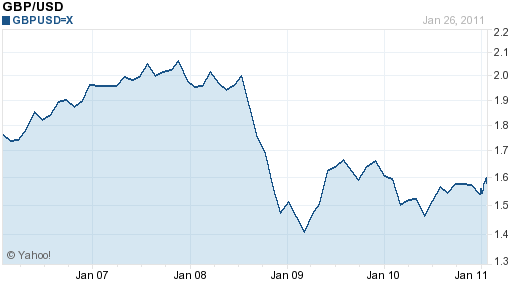
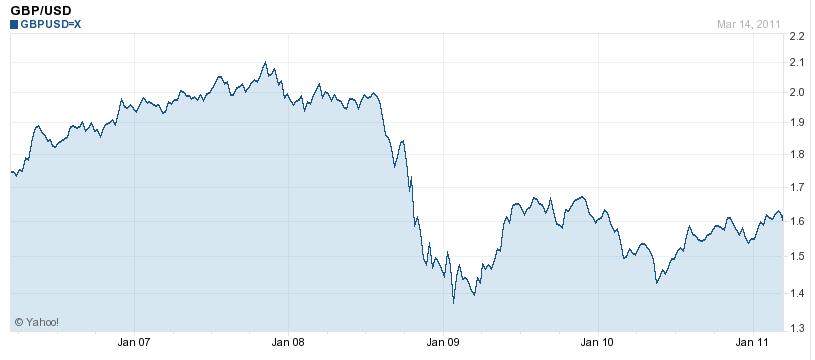
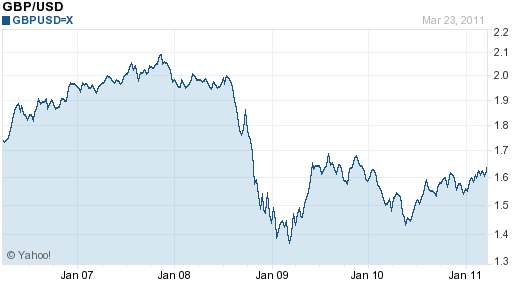
The last few years have been volatile for the British Pound. In 2007, it touched a 26-year high against the US Dollar, before falling to a 24-year low a little more than one year later. During the throes of the credit crisis, analysts predicted that it would drop all the way to parity. Alas, it has since managed to claw back a substantial portion of its losses, and finished 2010 close to where it started.

At the moment, however, there are two contradictory forces tugging at the Pound, which could send up upwards against the Euro but lower against the US Dollar. The first is the sovereign debt crisis in the EU, which flared up dramatically in 2010 and currently threatens to crippled the Euro. I will offer more commentary on this issue in a later post; for now, I just want to point out its role in supporting the Pound. While the Dollar is the Euro’s chief rival, many traders have turned to the Pound (and the Swiss Franc) because of their regional proximity. “As long as the euro-zone debt crisis is in the focus of the market, it will be the main driver of euro-pound,” summarized one strategist.
The second force (or set of forces) is propelling the Pound in the opposite direction. Basically, the UK economy remains depressed. Thanks to an unexpected contraction in the fourth quarter, GDP growth in 2010 was an exceptionally modest 1.7%. This was hardly enough to compensate for the average annual growth of .1%/year from 2006 to 2009, and send the Pound tumbling. Forecasts for 2011 and 2012 have since been revised downward to about 2%.
In order to spur Britain’s export sector, the Bank of England has deliberately acted to hold down the Pound, which it has managed to achieve through a combination of quantitative easing and low interest rates. “For a long time that’s what we were targeting, and we managed to get it down by about 25 percent — the exchange rate, that’s had a huge benefit to the U.K. economy,” a former member of the monetary policy committee recently admitted.

An unintended byproduct of this policy has been price inflation. At 3.75%, the inflation rate is among the highest in the industrialized world, and certainly the highest among G4 currencies. At the very least, the Bank of England will have to suspend any aspirations to match the Fed in printing more currency and expanding its QE program. It will probably also have no choice but to raise interest rates, which it might otherwise not have done until the economy is on more solid footing. The markets are currently projecting an initial rate hike of 25 basis points in the third quarter, and for the benchmark rate to exceed 1.5% by the end of the year, compared to .5% currently.
It’s difficult to say how the currency markets will make sense of this. Given that real interest rates will remain negative (due to inflation), it seems unlikely that any yield-seeking investors will suddenly start targeting the British Pound. In addition, given that the risk of ‘stagflation’ in the UK is now real and that the government is set to assume a record amount of new debt over the next few years, risk-averse investors will probably stay away. According to the latest Commitment of Traders report, speculators are already starting to establish bearish positions against the US Dollar.
While the Pound looks vulnerable, the big unknown is ultimately the EU fiscal crisis. If one of the peripheral members leaves the Euro, as some commentators predict will finally happen, then all bets (for the Pound, etc.) are off.

British Pound Continues Gradual Ascent

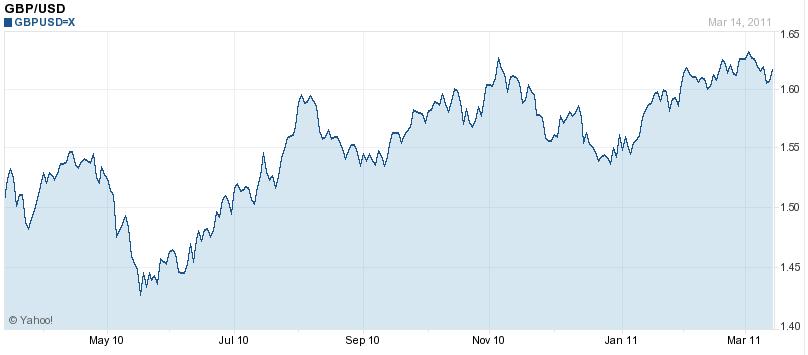
The British Pound has risen almost 15% against the Dollar over the last twelve months. It seems that the markets are ignoring the fiscal concerns that sent the Pound tumbling in 2010, and focusing more on inflation and the prospect of interest rate hikes. At this point, the Bank of England (BOE) is now racing with the European Central Bank (ECB) to be the first “G4″ Central Bank to hike rates.

You can find cause for optimism towards the Pound in technical factors alone. That’s because while dozens of currencies appreciated against the Dollar in 2010, most were starting from a stronger base. For example, the Canadian and Australian Dollars collapsed during the credit crisis. However, both currencies made speedy recoveries to the extent all losses were erased in only two years. The British Pound, in contrast, still remains 25% below its pre-credit crisis high, more depressed than perhaps any other currency.
On the one hand, this is probably justifiable. The British economy is still in abysmal shape; the latest GDP figures revealed a .6% contraction in the fourth quarter of 2010. Meanwhile, the ECB forecasts only 1.4% growth in 2011, and many analysts think that might even be too optimistic. With the exception of Japan, which suffers from a unique strain of economic malaise (not to mention the 5% hit to GDP caused by the earthquake), the UK is unequivocally the weakest economy in the industrialized world.
On the other hand, this is mostly old news. The reason that investors are starting to get excited is interest rate hikes. According to the minutes from its March meeting, the BOE voted 6-3 to hold its benchmark interest rate at .5%. That means its awfully close to acting. The market consensus is for a 25 basis point rate hike in the next three months, and 2-3 additional hikes over the rest of the year. Depending on how the other G4 Central banks act, that will put the UK rates at the top of the pack.
However, it’s unclear how extensive this tightening will be. According to one analyst, “The probability of a hike in the next three months is significant but the lingering credit crunch, fiscal tightening and bleak outlook for real incomes suggest that if this is the beginning of a tightening cycle, it will be a very shallow one.” Moreover, low bond yields suggest that long-term inflation expectations (and hence, the need for rate hikes) remain low.

At this point, it looks like the UK is looking at a few years of stagflation. That’s certainly going to be bad for UK consumers and probably negative for most UK asset prices. However, short-term currency speculators are less concerned about economic fundamentals, and more concerned about (risk-adjusted) interest rate differentials. That means that if the BOE fulfills expectations, the Pound will probably get a little short-term kick.

Pound Vs. Euro: Tie Game for Now?

While I’m fondest of analyzing all currencies relative to the Dollar (after all, it’s what I’m most familiar with and is involved in almost half of all forex trades), sometimes its interesting to look at cross rates.
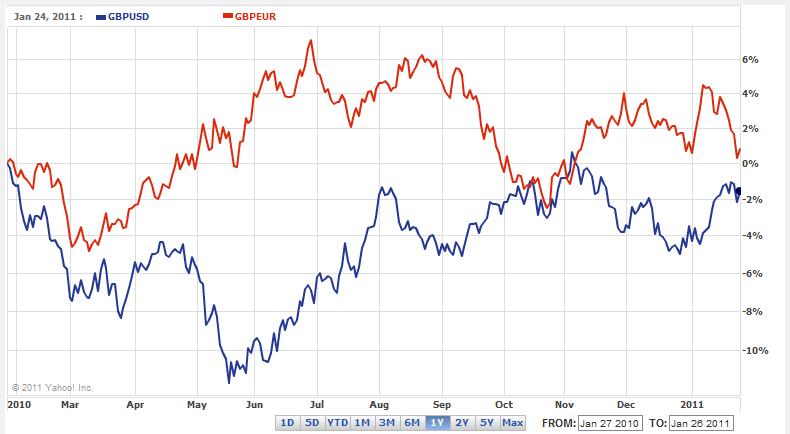
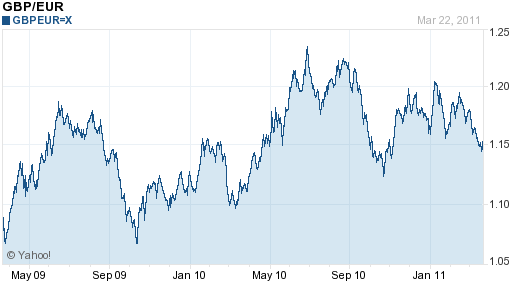
Take the Pound/Euro, for example, arguably one of the most important crosses, and one of a handful that often moves independently of the Dollar. If you chart the performance of this pair over the last two years, however, you can see the distinct lack of volatility. It has fluctuated around an axis of 1.15 GBP/EUR, never straying more than 5% in either direction. In fact, it’s sitting right at this level as I compose this post.

Yesterday, I read some commentary by Boris Schlossberg (whom I interviewed in 2010), Director of Currency Research at GFT. In the title (“Euro and Pound Go Their Separate Ways”), he seemed to suggest that a big move was imminent. Aside from noting that both currencies stand at crossroads, he declined to offer more concrete guidance on the direction of the potential breakout.
At the moment, the markets are gripped by risk aversion, caused by the Mid East political turmoil and the Japanese natural disasters. Once these events run their course and the accompanying market tension subsides, investors will need something else to latch on to. Perhaps the Bank of England (BoE) and European Central Bank (ECB) can fulfill this function, since both are on the verge of hiking their respective benchmark interest rates . Absent any other developments, the timing and speed of such hikes will probably dictate not only how these currencies perform against each other, but also how they perform against the Dollar.
Despite the numerous indications that both have given to the contrary, I don’t think either Central Bank is in a hurry to raise interest rates. Economic growth remains poor, unemployment is high, and inflation is still moderate. Neither is yet at the stage where it can unwind the monetary easing that it put in place at the height of the financial crisis. Moreover, both are wary about the potential impact of rate hikes on their respective currencies (a concern that I am ironically fomenting with this post).
It looks like the BoE will be the first to act. Combined with high energy prices, the bank’s easy monetary policy is putting extraordinary pressure on prices, and it now appears that inflation could reach 5% in 2011. In addition, the BoE voted 6-3 at its last meeting in favor of tightening, which means that a hike probably isn’t too far off. On the other hand, the ECB is talking tough, but it still doesn’t have much of an impetus to act. Inflation is moderate, and besides, the region’s banks remain too dependent on ECB cash for it to serious contemplate being aggressive.
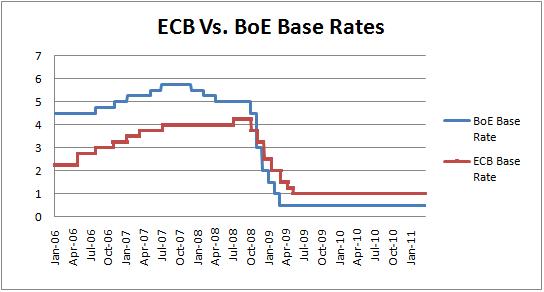
Either way, the interest rate differential probably won’t be great enough to encourage any short-term speculation between the two currencies. In addition, I think investors will continue to look to the Yen and the Dollar for guidance, and we won’t see any significant movement in either direction. [The chart below is based on benchmark lending rates and isn't necessarily applicable for retail forex trading].

This would create two opportunities for investors: Options traders should consider a long straddle, which involves selling a put and call at the same strike price (perhaps 1.15), pocketing the premiums, and praying that the rate doesn’t fluctuate much (since they would be exposed to unlimited risk). In the future, carry traders can also profit from the lack of volatility through a carry trading strategy, perhaps amplified by a little leverage. Be careful, however. Since interest rate differentials are currently so small (The current LIBOR rate disparity is a mere .05%!) and probably won’t widen to more than 1% over the next twelve months, any profits from interest could easily be wiped out by even the smallest adverse exchange rate movements.

Forex Reserve Plan could Harm Pound

Yesterday, UK Chancellor George Osborne announced that his government was ready to begin rebuilding its foreign exchange reserves. Depending on when, how, (or even if) this program is implemented, it could have serious implications for the Pound.
Forex reserve watchers (myself included) were excited by the updated US Treasury report on foreign holdings of US Treasury securities. As the Dollar is the world’s de-facto reserve currency and the US Treasury securities are the asset of choice, the report is basically a rough sketch of both the Dollar’s global popularity and the interventions of foreign Central Banks. Personally, I thought the biggest shocker was not that China’s Treasury holdings are $300 Billion greater than previously believed (with $3 Trillion in reserves, that’s really just a rounding error), but rather that the UK’s holdings declined by 50% in 2010, to a mere $260 Billion.

Given that the Bank of England (BoE) injected more than $500 Billion into the UK money supply in 2010, I suppose that shouldn’t have been much of a revelation. After all, selling US Treasury Securities and using the proceeds to buy British Gilts (sovereign debt) and other financial instruments would enable the BoE to achieve its objective without having to resort to wholesale money printing. In addition, if not for this sleight of hand, UK inflation would probably be even higher.
Still, this is little more than a mere accounting trick, and those funds will probably still need to be withdrawn from the money supply at some point anyway. Whether the BoE burns the proceeds or reinvests them back into foreign instruments is certainly worth pondering, but insofar as it won’t impact inflation, it is a matter of economic policy, and not monetary policy.
As Chancellor Osborn indicated, the UK will probably send these funds back abroad. In addition to providing support for the Dollar (as well as another reason not to be nervous about the upcoming end of the Fed’s QE2), this would seriously weaken the Pound, at a time  that it is already near a 30-year low on a trade-weighted basis. After falling off a cliff in 2009, the Pound recovered against the Dollar in 2010, largely due to the BoE’s shuffling of its foreign exchange reserves. To undo this would certainly risk sending the Pound back towards these depths.

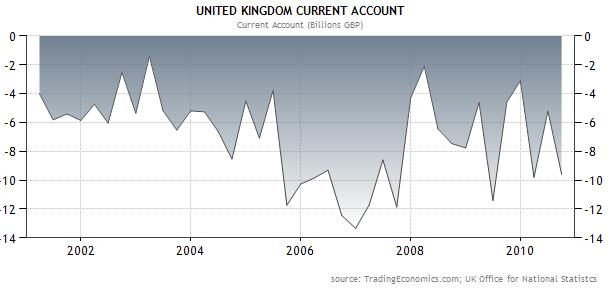
On the one hand, the UK is certainly conscious of this and would act accordingly, perhaps even delaying any foreign exchange reserve accumulation until the Pound strengthens. On the other hand, the BoE is under pressure to fight inflation. It is reluctant to raise interest rates because of the impact it would have on the fragile economic recovery. The same can be said for unwinding its asset purchases. However, if it offset this with purchases of US Treasury securities and other foreign currency assets, it could weaken the Pound and maintain some form of economic stimulus. Especially since the UK has run a sizable trade/current account deficit for as long as anyone can remember, the BoE has both the flexibility/justification it needs to coax the exchange rate down a little bit.
Ultimately, we’ll need more information before we can determine how this will impact the Pound. Still, this is an indication that the GBP/USD might not have much more room to appreciate.