‏إظهار الرسائل ذات التسميات Canadian Dollar. إظهار كافة الرسائل

السبت، 2 أبريل 2011

Canadian Dollar Edges Down on Quantitative Easing Fears

Despite an ebb in risk aversion, the Canadian Dollar is once again falling. Since touching a high of $1.18 in January, the Loonie has zigzagged its way downwards and hovered around $1.25. March 31 marked the end of its third straight quarterly decline.
canadian-dollar-falls
With the exception of the Japanese Yen (which is declining due to economic factors), virtually every currency has risen against the US Dollar in recent weeks. Stock market rallies have been accompanied by a general pickup in risk tolerance, and investors are piling back into assets and currencies that had been abandoned during the worst of the credit crisis. Why, then, has the Canadian Dollar been excluded from this rally?
Investors cannot be faulted for focusing on the abysmal Canadian economic situation. Employment, public and private spending, and construction – to cite a few indicators – are all falling at alarming speed. As a result, “the nation’s economy, the world’s eighth largest, will shrink at an 8.5 percent annualized pace in the first quarter, the largest decline since at least 1961.” Given that the picture is equally grim throughout the world, however, there must be another explanation.
Cue Mark Carney, head of Canada’s Central Bank, who has announced that Canada will “adopt a much milder version of the U.S. and U.K. strategy of printing more money to fight the recession.” Euphemistically referred to as “quantitative easing,” such a policy involves the injection of cash directly into credit markets and government bond markets, with the dual purpose of creating liquidity and stimulating the economy.
The concern, especially among forex traders, is that printing money will lead to inflation further down the road. When similar policies were announced by the Central Banks of the US, UK, and Switzerland, for example, their currencies plummeted instantly. In the words of one trader, “The precedent is a haircut right off the currency.” The Central Bank of Canada does have a reputation for being conservative, which suggests that it is likely to pursue quantitative easing only as a last step, and in a measured dose.
Accordingly, there is still some bullish sentiment surrounding the Canadian Dollar. One analyst even urges readers to “Consider the Canadian Dollar as a Possible Inflation Hedge,” partly on the basis that “The Loonie is a commodity based currency, so stronger commodity prices mean a stronger Loonie.” Given that crude oil and base metals prices are extremely correlated with the Loonie, this is a fair point.
“Canada’s currency will fall 3.3 percent to C$1.27 to the U.S. dollar by July, from C$1.2298 on April 3, according to the median forecast in a Bloomberg News survey of 40 economists and analysts.” Whether this prediction actually obtains depends primarily on what, if anything, Mark Carney and his colleagues at the Central Bank of Canada decide at their next meeting, scheduled for April 23.

Investors Bullish on Canadian Loonie Despite Record Interest Rate Cut

Today, the Bank of Canada followed up on an earlier promise by formally clarifying its position on quantitative easing. Suffice to say that the markets breathed a huge sigh of relief when it was revealed that the BOC was not committing itself to such a program. ” ‘The market has always had great trepidation about the idea of printing money…As the Bank of Canada has pushed back at that notion, the Canadian dollar is having a little party of its own,’ ” quipped one analyst.
In other words, the BOC would like to avoid following in the footsteps of its counterparts in the US, UK, Japan, and perhaps the EU, by pumping newly-minted money directly into credit and government bind markets. At the same time, the Bank admitted that a rapid deterioration in the Canadian economy would certainly prompt it to reconsider. Governor Mark Carney et al have approached the subject of quantitative easing coyly. On the one hand, today’s report (as well as the BOC website) contain detailed explanations of what quantitative easing would hypothetically entail. On the other hand, they insist that such a scenario does not fit with their economic projections, and hence remains unlikely. “The need to do extraordinary easing is a ‘big if,’ ” in the words of Governor Carney.
This is largely consistent with analysts’ expectations, one of whom had predicted that “it’s also quite possible the bank could simply lay out a framework on Thursday and not take any action at all.” Even ignoring the inflationary implications of quantitative easing, it’s not clear whether such a policy could even be effective. “The corporate bond market is reviving, with spreads narrowing and issuance levels improving, raising the question of whether central bank involvement is necessary or appropriate in a market that seems to be healing itself.” Granted, most investors are now wearing their rose-tinted glasses, but the data speaks for itself.
The BOC’s estimation that it can avoid quantitative easing is somewhat dubious, since it is predicated on overly optimistic economic forecasts, as well as because it has already exhausted the primary tool in its monetary arsenal. Earlier this week, it lowered interested rates to a record low of .25%, capping a 16-month period of easing, during which it slashed rates by 4.25%. By the Bank’s own reckoning, interest rates will remain low until mid-2010, as inflation is now comfortably within the target range of 1-3%.
Given the abysmal economic situation, it is no surprise that inflation has moderated. Commodity prices are well below the record highs of 2008. Aggregate demand, and GDP by extension, are retreating in kind. According to one economist, ” ‘When you do that math, no matter how optimistic you are, you are talking about a time frame of years before things like the unemployment rate (are) back down to historically normal levels.’ ”
Still, traders remain bullish on the Loonie. “Since March 9, the loonie has climbed 6.2 percent…The loonie will appreciate to C$1.19 by the end of March next year, according to the median forecast of 38 economists and analysts in a Bloomberg survey.” As the Forex Blog reported in yesterday’s post, the carry trade has returned, which is good news for commodity currencies, low interest rates are not. Meanwhile, low interest rates could stimulate corporate borrowing and home buying. Given the Central Bank’s reluctance to print money, the economic recovery would even unfold without the drag of inflation. Maybe the excitement is justified…

Canadian Dollar Inches Closer to Parity

After finishing 2008 on a low note and getting off to a disastrous start in 2009, the Canadian Dollar (“Loonie”) is slowly clawing its way back. It has now risen over 14% since the beginning of March, and is up 7 cents in May alone, en route to a seven-month high. Circumstances have changed so rapidly that no one could have seen this coming. “The rising Canadian dollar has taken some forecasters by surprise; recent predictions by some Canadian banks said the dollar would be in the high 70-cent US to mid-80-cent range by June.”
canadian dollar inches towards parity with usdAfter all, Canadian economic fundamentals remain abysmal by any standards, because of the collapse in commodity prices and a decline in exports to its biggest trade partner, the US. “Canada’s central bank has said the country’s gross domestic product fell 7.3 percent in the first three months of 2009, dropping at the steepest pace in decades. The Bank of Canada said that’s the biggest contraction since comparable records began being kept in 1961.” Meanwhile, the economy has shed almost 300,000 jobs, and the government is predicting a record budget deficit of 50 billion Canadian dollars.
Due in part to a rise in commodity prices (which could soon make it profitable for drilling of the famous oil sands) as well as the government’s $32 billion economic stimulus package, Canada’s luck is expected to turn. The economy is now expected to grow by a healthy 2.5% in 2010, following a projected decline of 3% in 2009. This return to prosperity will be made possible be a shift in economic strategy, as a part of which East Asia could supplant the US as Canada’s biggest export market.
So, why is the Loonie rising? In a nutshell, it is for the same reason that most other currencies are outperforming the Dollar. One analyst offered the following pithy summary: “This is not a made-in-Canada story, but a negative U.S. dollar story.” In other words, currency traders are focusing more on lowered risk aversion and the Fed’s money printing activities, rather than economic fundamentals. As commodities and stocks recover, the Loonie is being driven up indirectly- not because investors suddenly perceive it as having some kind of economic advantage.
In the near-term, “Canada’s dollar will weaken to C$1.18 by the end of this year, according to the median forecast of 41 economists and analysts surveyed by Bloomberg News.” Perhaps with a similar inkling in mind, the Bank of Canada appears unlikely to intervene in currency markets at the moment. To be sure, it has already exhausted the main weapon in its monetary arsenal by cutting rates to .25% and is certainly looking for ways to stimulate the economy. But for the time being, it is prepared to accept currency appreciation as long as it is offset/accompanied by improvements in other areas. Said one analyst, “I think the Bank of Canada could tolerate some back-door tightening from the currency if it’s happening at a time when everything else is looking sunnier.”

BOC Nervous about Loonie Appreciation, but Not Enough to Take Action

Canada right now seems to typify the contradiction between political posturing and economic reality. GDP dropped by a whopping 5.3% in the first quarter- less than what the Central Bank had predicted but greater than thr 3.7% drop in the previous quarter. “The economy will shrink by 3 percent this year, the central bank predicts. That would be the biggest drop since 1933, according to Statistics Canada. The unemployment rate has also been at a seven-year high of 8 percent the last two months.” The most grim statistic is that “Canadian exports fell an annualized 30.4 percent in the first quarter, led by the automotive industry.” This is particularly problematic for Canada, whose economy is 30% depending on such exports.
Meanwhile, Canada’s Prime Minister, Steven Harper, is bandying the term “green shoots” around, and has declared “The worst is behind us now.” I guess it just depends on which statistics you choose to cite. After all, “April data…showed new jobs were created for the first time in six months and sales of existing homes rose the most in more than five years. Credit markets are also improving, with the Bank of Canada’s composite index of financial market conditions rising to its strongest level last month since September.” Still, a majority of surveyed economists forecast economic contraction for at least another quarter.
At least the Bank of Canada seems to have two feet planted firmly on the ground. It has warned investors not to expect a rate hike (from the current record low of .25%) for about a year, although it admits that could change depending on inflation. The BOC has thus far abstained from unveiling a massive “quantitative easing” plan to match that of the UK and US, which were subtly gibed for not having viable “exit strategies.” In addition, while Canada’s outstanding public debt has surged past $500 Billion, the country’s debt/GDP ratio is still the lowest in the G8 and projected to remain stable (despite projections of deficit for the next five years). In short, inflation inflation is probably not a realistic concern.
What is worrying to the Bank of Canada is the rise in the Loonie, which has surged 14% since March and shows no signs of stopping. In its decision last week to maintain rates at current levels, the BOC referred to “the unprecedentedly rapid rise in the Canadian dollar (which reflects a combination of higher commodity prices and generalized weakness in the U.S. currency).” Given that it can’t cut rates any further and is reluctant to devalue the currency through printing money, the only real option is for the Central Bank to intervene directly in currency markets, last done in 1998. Analysts, though, reckon that this is extremely unlikely.
What would it take for the Loonie to return to a more sustainable level? A decrease in risk appetite, for one thing. If investors got spooked and returned to the Dollar, this would probably crunch the Canadian Dollar. More likely, at least in the short-term, seems to be a retreat in commodity prices. The Loonie has pretty closely tracked the recovery in commodity prices [see chart below], any any pullback in oil and metals would likely be reflected in decreased demand for the currency. A recent report in the NY Times suggested that the surge in Chinese buying activity – which was clearly correlated with rising prices – may soon come to an end. The inevitable fall in commodities prices that would follow will certainly help officials at the BOC to sleep better.
Loonies is Correlated with Commodity Prices

Canadian Dollar Slated to Outperform Other Commodity Currencies

In the same vein as Monday’s and Tuesday’s posts (covering the New Zealand Dollar and Australian Dollar, respectively), I’d like to use today’s post to look at another commodity currency – the Canadian Dollar. The Loonie, it turns out, has also benefited from the a recovery in risk appetite and concomitant boom in commodity prices; it has appreciated by 7% against the USD in the last month alone, en route to a ten-month high. “All in all, with almost everything going its way these days (besides the crummy weather and the impact on tourism), a return trip to parity – last visited nearly one year ago – doesn’t seem far fetched,” chimes one optimistic analyst.
cad-usd
Like Australia and New Zealand, Canada’s economic fate is tied closely to commodity prices. Simply, as oil and other natural resources have inched closer to last year’s record highs, the Loonie has rebounded proportionately. “Raw materials account for more than 50 percent of Canada’s export revenue. Crude is the nation’s largest export.” Of course, this relationship works both ways. Any indication that the global economic recovery is stalling, and commodities prices would likely tumble, bringing commodity currencies down likewise.
Unlike the Australian Dollar and New Zealand Dollar, the Loonie has never really held much appeal as a carry trade currency. Even at their peak, Canadian interest rates were mediocre, from the standpoint of yield. The current rate is a measly .25%, compared to 2.5% in New Zealand and 3% in Australia. Moreover, while Australia may begin tightening as soon as the fall, “The Bank of Canada committed to keep its key policy rate at the lowest possible level until the spring of 2010,” after voting to hold rates at yesterday’s rate setting meeting. This interest differential could explain why the Aussie has outpaced the Loonie of late.
cad-aud
Another key difference – and potential explanation for the currencies’ recent divergence – is that Australia is considered part of the Asian economic zone, while Canada’s economic fortunes are closely aligned with those of its main trading partner, the US. China, alone, is helping to lift Australia out of recession. The US, meanwhile, is still struggling to find its feet. Hence, it is projected that Canadian GDP will contract by 2.3% in 2009, while Australian GDP may fall by a modest .5%. “When things look bad, you are more likely to sell Canada than the Australian dollar because its economy is moderated by Asian growth,” explains one analyst.
Going forward, this regional differentiation could actually work to the advantage of Canada, which is forecast to grow by an impressive 3% in 2010, compared to 1% growth in Australia. Accordingly, one analyst advises that “Investors should sell Australia’s dollar against Canada’s as a ‘relative commodity play’ because an attempt by China to reign in bank lending on concern it may be creating asset-price bubbles could slow Asian growth…’The Canadian dollar should outperform because it is much more closely linked to a recovery in the U.S.’ “

Canadian Dollar Volatility could Spur Intervention

Since the Forex Blog last covered the Canadian Dollar – on July 29 – the Canadian Dollar appreciated another 2% against the US Dollar, reinforcing the perception that the currency is both too volatile and appreciating too rapidly. This concern is harbored by the Central Bank officials and policymakers, which fear that the rising currency represents the proverbial wrench in the Canadian economic recovery.
cad-chart
From a volatility standpoint, it looks like their concerns are justified. “For years it was traditional for the cost of a one-week option on the Canadian dollar to be 20 to 25 basis points…The cost is now commonly in the 50-point to 75-point range and in the last six months it has been as high as 100 points.” On a relative basis, the currency is also more volatile than the commodities with which it is commonly associated. In the last two months alone, it recorded both a 7.4% plunge and a 10% rise. To be fair, short-term volatility is lower than it was one year ago, but this isn’t going to placate those who insist that it’s still too high.
canadian-dollar-volatility
Looking at the charge that the Canadian Dollar has risen too rapidly, this too appears valid. One could argue that the thundering 20%+ rise since March was simply a retracement (in FX terminology), necessary to offset the even bigger decline that took place following the onset of the credit crisis. This argument, however, ignores the notion that the Loonie was probably overvalued before it fell. At that time, commodity prices were sky-high, and expectations were that they would remain high, if not soar even higher. Since then, they have fallen precipitously, to less than half of the record highs recorded during the peak of the bubble.
cad-effective-exchange-rate1
Speaking of commodity prices, “At the time of its [the Bank of Canada's] last statement, oil prices were about $75 a barrel, but now they are in the $60-to-$65 range. That suggests the currency’s appreciation has outpaced the demand for its commodity exports.” In other words, the Loonie’s recent rise can be attributed more to speculation, than to a change in fundamentals. “The rise in the dollar reflects ‘hot money seeking alternatives to the greenback,’ not the underlying economic strength,” agrees one analyst.
The Bank of Canada, naturally, views this as a problem, and “Bank of Canada Governor Mark Carney says he is prepared to intervene in currency markets if the Canadian dollar’s rise persists and threatens to smother the ‘nascent’ recovery. If not for the uncertainty surrounding the Loonie, in fact, BOC officials are quite confident that Canada’s economy would grow consistently in the near-term.
The Central Bank’s options are limited, since its main policy rate is already close to zero. This can still be tweaked, explains one analyst. “If you thought you were going to tighten in the first half of 2010 and the currency shoots to parity at some point, maybe that means you don’t get there until the end of 2010.” The bank’s only other monetary policy option is qualitative easing (i.e. printing money), which at this point in the cycle, seems unlikely.  “Intervening in currency markets to quell the Canadian dollar’s strength is also an unattractive option for the bank, which views intervention without accompanying monetary policy action as ineffective. That leaves commenting on the currency as the only really agreeable option for the bank.” However, given that the Loonie has continued to appreciate in spite of Carney’s warnings, it seems traders have disregarded these threats as mere idle talk. To parity we go!

Bank of Canada Versus the Loonie

I toyed with the title of this post for a while, and ultimately settled on the current iteration, because it reflects the battle that is being waged between the Bank of Canada and the forex markets. Simply, the Loonie is moving in one direction (up!), while the BOC would prefer that it moves in the opposite direction.
Let’s start with some context: the Canadian Dollar’s performance this year has been impressive, to say the least. 2009 is far from over, and yet the Loonie has already risen 14% against the Dollar, almost completely undoing the record 18% slide in 2008. Analysts are quick to point to the nascent Canadian economy, fading risk aversion, and the ongoing boom in commodities prices as behind the currency’s rise.
While all of these reasons are certainly valid, they hardly tell the whole story. Consider that Canadian growth remains tepid, deflation is now a reality, its currency is outpacing commodity prices, and its budget deficit will probably set a record this year. Regardless of what the future holds for the Canadian economy, the present remains nebulous. Thus, it seems the best explanation for Loonie strength is not to be found in Canada, but across the border in the US. Specifically, it is US Dollar weakness, and momentum-driven speculation based on the expectation of further weakness, that is driving the Canadian Dollar.
From the Bank of Canada’s standpoint then, the Loonie’s move back towards parity has nothing to do with fundamentals, which is why the BOC maintains that the currency represents a threat to both recovery and price stability. He has a point on the second front, since inflation is currently running at an annualized rate of -.8%, marking three consecutive months of deflation. “The [inflation information] has proved the Bank of Canada’s concerns are justified,” confirmed one analyst.
The Million Dollar Question then, is how far the BOC is willing to go to halt the Loonie’s ascent. Bank of Canada Governor Mark Carnet has already intervened vocally, by repeatedly signaling his displeasure with recent developments in forex markets, and suggesting that all options remain on the table. But rhetoric only goes so far, and after a brief pause, the Canadian Dollar has resumed its rally. “We think [rumors of intervention] it’s 100 percent untrue. I don’t think the bank has the ammunition or the desire to intervene. This is a story about U.S. dollar weakness across the board,” said one trader.
cad
The Bank has already exhausted most of the tools in its monetary arsenal. It recently voted to maintain its benchmark interest rate at the current record low level of .25%, and beyond extending the period of time during which it maintains low rates, there isn’t much more it can do on this front. Besides, conveying an intention to hold rates at .25% beyond June 2010 might not influence investors, who don’t seem too concerned about low yields offered by the Loonie. Moreover, it remains loath to copy the quantitative easing implemented by the Fed and Bank of England, because of the tremendous amount of work required to mop up“that increase in liquidity when the time comes.
In other words, the only thing the BOC can do at this point is to actually intervene, probably by buying US Dollars on the spot market. A couple obstacles are the fact that the BOC hasn’t intervened for over 10 years, and that Prime Minister Stephen Harper is simultaneously trumpeting the importance of “flexible exchange rates” in speeches intended to denigrate China.
In fact, the BOC may not have to get involved, since the consensus among analysts is that the Loonie will trade sideways for the next year. “According to…52 strategists polled by Reuters…In three, six and 12 months, the median estimate of those polled had the domestic currency steady at $1.100 to the U.S. dollar, or 90.91 U.S. cents.” Moreover, polled analysts based their forecasts on a mere 17.5% of intervention, which means that irrespective of the BOC, most forecasters think that the Loonie has reached its potential…for now.
Of course, if the Loonie fulfills estimates at the high end of the poll – especially in the short-term, and if inflation remains negative, the BOC could find itself with no other choice. But for now, investors aren’t holding their breath.

Bank of Canada Still Mulling FX Intervention

The Canadian Dollar fell from parity with the US Dollar in July 2008. For a minute, it looked as though it would return to that mark in October 2009. Alas, it was not to be, as the currency that had risen 20% since March wasn’t able to rise another 3% to close the elusive gap that would once again bring it face-to-face with the Greenback.
cad
The Loonie’s rise was not difficult to understand. Soaring commodity prices and the fact that the economic recession was milder in Canada than in other economies drove the perception that Canada was a good place to invest. Despite a surging budget deficit and weak domestic consumption, investors bought into this notion. The weak Dollar and rising risk aversion reinforced this perception, and as investors accepted that parity was inevitable, hot money poured in and the Loonie’s rise became self-fulfilling.
That was until Mark Carney, head of the Bank of Canada, used the strongest rhetoric to-date in discussing the possibility of intervention. For the first time in this cycle, the markets took the hint, and sent the Canadian Dollar down by the largest single-day margin in months. “Markets should take seriously our determination to set policy to achieve the inflation target. Markets sometimes lose their focus, we don’t lose our focus,” he said firmly, adding that forex intervention is “always an option.”
Intervention is supported both by economic data, and other Canadian institutions. According to one estimate, every 1 cent increase in the Loonie against the Greenback costs the county $2 Billion in export revenue and 25,000 jobs. The chief economist for CIBC, meanwhile, has warned that many companies are in the process of making long-term direct investment decisions, and could be discouraged from locating in Canada because of perceptions that its currency will remain strong for the immediate future: “If the loonie is overvalued for a few years, we may be sacrificing business plant and equipment on the altar of a strong currency.” He also compared the predicament facing the Bank of Canada to that facing the Royal Bank of Switzerland, which ultimately and successfully intervened on behalf of the Franc. Intervention on behalf of the Loonie, he argued, could be undertaken under the umbrella of fighting speculation and irrational movements in currency markets.
Prior to this outburst, investors had basically concluded that the BOC wasn’t prepared to put its money where its mouth was, so to speak. “The central bank’s shot across the bow has definitely subsided. There’s not much they can do,” summarized one analyst a few weeks ago. The term “jawboning” had become the preference of columnists and investors when discussing the resolve of the BOC. The belief was that the BOC had concluded that intervention was essentially a futile proposition (based on its failed efforts in the late 1990′s), and that it would instead resort to making idle threats.
In fact, it seems investors still are no convinced that the BOC (via Carney) means what it says. “Mark Carney has raised the prospect of intervening in currency markets, but seems reluctant to actually do so,” argued one analyst. “I don’t think they would really like to intervene at all, and they would prefer avoiding it. If they can intervene by jaw boning, they would much rather do that,” added another.
Why did the Loonie fall suddenly then, if the markets still aren’t concerned about intervention? The answer is that they have seen the concrete impact of the expensive Loonie on the Canadian economy. In the words of one analyst, it has moved from being a threat to a bona fide impediment. Especially given the stall in the commodity price rally, investors apparently are willing to acknowledge that they may have gotten ahead of themselves and that parity with the Dollar is not yet justified by fundamentals. Meanwhile, Canadian interest rates are at a comparable level with US rates, which means foreign investors can’t earn a yield spread from investing in Canada. This is likely to be the case for a while, as the valuable Loonie has kept inflation in check and given the BOC some flexibility in tightening its monetary policy.
Personally, I don’t think the BOC will ultimately intervene. Investors have shown that they aren’t afraid of the BOC, which would make any intervention both expensive and unfruitful. In addition, I think investors have accepted their own accesses, and will hesitate to push the Loonie much higher (or past parity, for that matter) until there is more evidence that such is justified. In the meantime, expect the Loonie to hover in the 90′s and perhaps even test parity, before smashing through when the time is right. And this, I do believe, is inevitable.

Playing Chicken with the BOC

The Canadian Dollar has been one of the world’s top performers this year, especially relative to the Dollar. The Bank of Canada is less than thrilled about this distinction, which is why it takes advantage of nearly every opportunity to remind the markets that it will do everything in its power to prevent the Loonie from rising further. The markets are beginning to wonder, however, whether the BOC is actually prepared to put its money where its mouth is, if push comes to shove.
It’s impossible to say definitively whether the Canadian Dollar’s rise is justified by fundamentals. On the one hand, the ongoing economic recovery and commodities boom will specifically benefit resource-rich economies, such as Canada. It’s no surprise that Canada has been one of the most popular destinations for so-called “risk-averse” investment. Summarized one analyst, “It all revolves around the risk-aversion trade. Last week with equity markets and commodities selling off, we also saw the Canadian dollar selling off in that environment. Today the market settled down a little bit, so we were able to see the Canadian dollar claw back some of its losses.” In addition, it’s not as if the Loonie’s appreciation has been universal. Its gains are primarily against the US Dollar; in this sense, it has merely been subsumed into a larger trend, rather than having been singled out by forex traders.
On the other hand, the economy is forecast to contract in 2010, before returning to full capacity at some point in 2011. The Bank of Canada has flooded the market with currency, via its own version of quantitative easing. Non-commodity exports are stalling, and the government is running record budget deficits. The benchmark interest rate is only .25%, and the BOC has committed to holding it there until June 2010, barring any unforeseen developments. Thus, there is no “positive carry” to be earned from parking money in Canada.
In the context of forex intervention, this analysis is almost beside the point, since the BOC is clearly impervious to logic. Its decision to intervene at this point will probably be based less on economics and more on politics. You see, the Bank has left itself with very little wiggle room, should the Canadian Dollar continue to rise towards, or even past parity with the US Dollar. Its rhetoric has been fairly consistent; whether or not it actually has the wherewithal to intervene successfully (it probably doesn’t) it has conveyed to the markets that has both the means and the determination.
As a result, the BOC has pushed itself into a no-win situation. If the Loonie appreciates further and it doesn’t intervene, then it will have very little credibility going forward. If the Loonie rises and it does intervene, it risks incurring the wrath of the international community and wasting money towards a futile cause. “It’s hard for a modest-sized central bank such as Canada’s to flood the market with so much currency that it alters the balance of the world’s huge and complex foreign-exchange markets,” explained one economist.
canadian dollar
The Bank’s best hope is that the markets continue to take its threats seriously and abstain from betting on the Loonie. For now, it looks like this is the case. “No one wants to go heavily long through the next few months in fear that the Bank of Canada does step in some way,” said one trader. In fact, the threat of intervention may have even brought speculators into the market to bet against the Loonie, having derived support from the last round of intervention (1998): “Traders took the bank’s willingness to intervene as an open invitation to bet heavily on the other side of the equation – knowing they had a big trading partner back-stopping their bet.”
It’s basically a giant game of chicken between the markets and the BOC. Who will blink first?

Canadian Dollar Headed for Parity

Only a year ago, who could have conceived of such a possibility? At the time, the Canadian Dollar (aka Loonie) was in the doldrums, as a result of the credit crunch and concomitant collapse in commodity prices. In March, however, the Loonie began an extraordinary rally, and finished the year up 16%, almost perfectly offsetting the record decline that it suffered in 2008. As a result, the Loonie is now only pennies away from returning to parity.
The Loonie’s rise can be ascribed to a combination of fundamentals and speculation. On the fundamental side, a surge in the price of oil and other commodities has driven a recovery in the Canadian economy. Summarized one strategist, “The fundamentals in Canada are strong. Sentiment is bullish Canada, and on a relative basis, Canada should do very well with stronger commodity prices and ongoing U.S. economic recovery.” On the other hand, non-commodity exports remain sluggish, such the current account balance is currently in the red.
It’s obvious then that the gap between reality and expectation is being filled by speculation. Despite the fact that both short-term and long-term Canadian interest rates remain low, investors are pouring money into Canadian assets in the hopes that rates will soon rise. This speculation reached a fever pitch in October of 2009, when the Loonie spiked 6% in less than two weeks, following a modest Australian rate hike.
At that point, Canadian Central Bank governor Mark Carney was forced to firmly step in (previously he had effectively remained on the sidelines) by warning investors that he was in no hurry to lift rates, and that “he had ways of cooling the currency.” While analysts credit Carney’s jawboning with effecting a modest decline in the Loonie, it has since resumed its upward march, breaking through the technical barrier of 97.5 CAD/USD yesterday.
In the short-term, sheer momentum will almost surely carry the Loonie through parity with the Dollar. Analysts are divided on the timing, with some suggesting as soon as this month and others suggesting that later in the year is more likely. They should be careful, as there is an exuberance in the forex markets that I havn’t seen since right before Lehman Brothers collapsed- the event that many say signaled the beginning of the forex markets. In other words, investors are surely getting ahead of themselves, since commodities are well off of their 2008 highs, interest rates are down, Canadian economic growth is mediocre, Canada’s fiscal condition is weak, and it is operating a current account deficit.
For this reason, many analysts are already becoming bearish on the Loonie. “The loonie looks potentially more vulnerable on a number of crosses unless we see renewed upside momentum,” expressed a strategist from RBC Capital Markets. But noticed that she framed a continued rise in terms of momentum, rather than fundamentals. That’s tantamount to saying, Unless the Canadian Dollar continues to appreciate, it won’t continue to appreciate. If that’s not a tautology, I don’t know what is! But seriously, she has a point, which is that the Loonie is being driven purely by speculation at this point, in a trade that could soon come crashing down…after it hits parity.
Canadian Dollar versus commodities

CAD/USD Parity: Reality or Illusion?

In January, the Canadian Dollar (aka Loonie) registered its worst monthly performance since June. Many analysts pointed to this as proof that its run was over, after coming tantalizingly close to parity. Others insisted that the decline was only a temporary correction, a mere squaring of positions before the Loonie’s next big run. Who’s right? Both!
cad1
There are (at least) two separate narratives presently weighing on the Loonie. The first is causing it to decline against its arch-rival, the US Dollar, for reasons that essentially have nothing to do with the Canadian Dollar and everything to do with the US Dollar. Specifically, the mini-crisis that is playing out in Greece and the EU has caused risk aversion to resurface, such that investors are now returning capital to the US. One analyst explains the impact of this seemingly tangential development on the Loonie as follows: “When you get any sort of ‘risk-off’ type of environment like we’ve had over the past week or so, currencies like the Canadian dollar and the Australian dollar will come under pressure.”
The second narrative explains why the Canadian Dollar continues to hold its own against most other currencies. Specifically, Canada’s economic recovery continues to gain momentum as commodity prices continue their rally. In the latest month for which figures are available, the economy added about 80,000 jobs, more than five times what forecasters were expecting. This turn of events is helping to quash the “view that the Canadian trade sector is incapable of growth with a strong currency,” and making traders less nervous about sending the Loonie up even higher.
Going forward, there is tremendous uncertainty. Both short-term (determined by the Bank of Canada) and long-term (determined by investors) interest rates remain quite low, such that the Loonie is not really a candidate for the carry trade. In addition, the Bank of Canada hasn’t completely ruled out the possibility of intervention on behalf of the Loonie; it may simply leave its benchmark interest rate on hold (at the current record low of .25%) for longer than it otherwise would have. In addition, a series of recent tightening measures by the government in China threatens to crimp demand for commodities and weigh on prices. Finally, the market turmoil in Greece is causing investors to look afresh at the balance sheets (in order to weigh the likelihood of default) of other economies. This probably won’t help Canada, which continues to run large deficits and whose debt level once earned it the dubious distinction of “honorary member of the Third World.”
Still, Canada’s capital markets are among the most liquid and stable in the industrialized world, and if risk-aversion really picks up, it won’t suffer as much as some other economies. “The Canadian economy is not as structurally impaired as the U.S. or the U.K. It creates a sense that Canada is less exposed to the fickleness of foreign investors that are causing uncertainty in other locations.” In fact, the Central Bank of Russia just announced that it will switch some of its foreign exchange reserves into Canadian Dollars, and other Central Banks could follow suit.
cad2
While the Canadian Dollar should continue to hold its own against other currencies, the same cannot necessarily be said for its relationship to the US Dollar. “Options traders are the most bearish on the Canadian dollar in 13 months…The three-month options showed a premium today of as much as 1.34 percentage points in favor of Canadian dollar puts.” In other words, the price of insurance against a sudden decline in the CAD/USD is rising as investors move to cushion their portfolios against such a possibility. While this trend could ease slightly in the coming weeks, I personally don’t expect it to disappear altogether. All else being equal, given a choice between owning Loonies or Greenbacks, I think most investors would choose Greenbacks.

Why is the Loonie Beating the Aussie?

It sounds like the beginning to a bad joke, right? But seriously, why is the Canadian Dollar (aka Loonie) beating the Australian Dollar (AUD) when the two currencies are placed head-to-head?
The currency markets tend to be very Dollar-Centric, in that they tend to view most currencies relative to the US Dollar (and to a lesser extent, the Euro), rather than to each other. When it comes to the Aussie and Loonie, then, traders at the moment seem content to see them as relatively strong, since both are appreciating against the Dollar. After all, the AUD/CAD pair accounts for only a small fraction of overall trading activity, which means that liquidity is lower and spreads are higher. Why bother?
But this ignores the fact that an important battle is currently being waged by the two currencies not only against the Dollar, but also against the other. It’s not as if the AUD/CAD rate is determined solely based on triangular arbitrage (i.e. indirectly from the AUD/USD and USD/CAD). On the contrary, there are unique factors which determine this exchange rate irrespective of others, as well as specific financial instruments.
But enough with the palavering!Let’s try to understand the idea of parity as it exists between the Loonie and Aussie, and not relative to the Greenback. I like to begin any analysis by looking at a chart. But as with any financial chart, a different time period changes the whole picture. In this case, the 1-year chart shows the Australian Dollar gaining in 2009 (in fact it was the highest performer last year among all of the majors) from the lows of the credit crunch, but retreating in 2010 away from parity. It is this latter trend that I want to elucidate here.
CAD AUD 2009-2010
On paper, the Aussie would seem to be the clear favorite. As a result of this month’s interest rate hike by the RBA, the benchmark Australian rate (4%) is now a healthy 3.5% higher than its Canadian counterpart (.5%). This should favor the Aussie among carry traders looking for the highest yield differentials. In addition, the Australian Dollar accounts for a higher portion (6.7% versus 4.2%) of forex turnover than the Canadian Dollar, according to the most recent data, which means that the AUD wins the liquidity battle as well. Meanwhile, Australia’s public debt is near the low end among developed countries, at almost 15% of GDP. After a record 2009 budget deficit, Canada’s public debt is close to 80% of GDP and is among the highest the world. Finally, Australia’s economy was one of the first to emerge from recession (some say it never even officially entered recession), certainly before Canada.
But all of this is in the past. “Canada is on course to be the first Group of Seven nation to erase its budget gap after the global financial crisis.” [Australia should have won this distinction, but alas, it's not a member of the G7]. In 2009 Q4 (the most recent for which data is available), Canada’s economy grew at 5%, compared to 2.7% in Australia. While the US economy – Canada’s largest trade partner – is accelerating, China – Australia’s most important trade partner – is attempting to slow down.
While both the Aussie and Loonie are thought of as commodity currencies, the Loonie is currently benefiting from higher oil prices while the Aussie could suffer from peaking coal and iron ore prices. Volatility (as implied by options contracts) is lower for the Loonie, and this is just as significant as the interest rate differential, when it comes to the carry trade. When you consider finally that “Canada’s financial system was named the soundest in the world for two consecutive years by the Geneva-based World Economic Forum,” its banks are all financially sound, and the attention garnered by the Vancouver Olympics, it’s no wonder that the Loonie is now edging ahead.
Over the last five years, the two currencies have been pretty stable against each other. [Against a basket of other currencies, the Loonie is ahead, with a 20% total appreciation compared to the Aussie's 17% rise]. Thus, the current ebb could be a necessary correction. While analysts like to see things in terms of important psychological milestones, there’s no real reason why the two currencies should trade at 1:1 (parity), and the equilibrium value could very well be below the current level.
This is evidently how the markets feel, as the Aussie just slipped below its 200-day moving average against the Loonie for the first time since 2008. In addition, “Investors paid the largest premium in almost a year last month for Australian dollar put options versus the Loonie. The premium of contracts granting the right to sell the Aussie versus the Canadian currency in one week over those for buying increased on February 8 to 1.18 percentage points, the biggest since April 2009.” After all, the Aussie’s appreciation in 2009 was the highest in 15 years. Perhaps it’s only natural that all else being equal, it should fall a bit in 2010.

Canadian Dollar and Parity

The Canadian Dollar’s performance of late has been eerily redolent of its sudden rise in 2007, when propelled by nothing more than sheer momentum, it rose 20% against the Dollar and breached the parity mark (1:1) en route to a 30-year high. [Of course, we all remember what happened next: the credit crisis struck, and the Loonie plummeted even faster than it had risen].
CAD USD 5 year chart
Last week, the Canadian Dollar breached parity again, and after a brief retreat, it touched parity again today. On the one hand, this latest rise was simply a matter of making up for the ground lost in 2008, when risk-averse investors shifted capital en masse to the US. On the other hand, Canadian fundamentals are fairly strong, and that the Loonie is once again at parity is deservedly so.
Last week’s jobs report was pretty solid, but the Canadian unemployment rate is still high, at 8.2%, mirroring the “jobless recovery” phenomenon in the US. According to the Bank of Canada’s own estimates, GDP growth is projected at a healthy 3.7% for 2010, thanks to a strong recovery in oil and commodity prices. As a result, the Bank of Canada has finally given the indication that it is ready to hike interest rates, perhaps as soon as July.  After concluding its monthly meeting yesterday, it noted, “With recent improvements in the economic outlook, the need for such extraordinary policy is now passing, and it is appropriate to begin to lessen the degree of monetary stimulus.”
On the other hand, one has to wonder how long the momentum in the Canadian Dollar can continue. While Canada’s economic recovery has indeed been strong, it is no more impressive than the recovery in the US. (In fact, it should be noted that the two economies remain deeply intertwined). In addition, the (Canadian) economy is already expected to slow down slightly in 2011 (3.1%), and slow further in 2012 (1.7%), which makes me wonder whether the Bank of Canada will have to tighten slightly in order to achieve its inflation objectives. Moreover, while the BOC will probably hike rates slightly before the Fed, the arc of monetary policy followed by the two Central Banks will probably be pretty similar for the next few years, regardless of what happens.  This means that interest rate differentials between the two economies should remain pretty close to the current level (near 0%), and won’t expand enough to make a CAD/USD carry trading strategy viable.
It seems the futures markets concur, as the Canadian Dollar is projected to hover around parity with the USD for the bulk of the next 12 months. Granted, futures prices have pretty closely mirrored the Canadian Dollar’s performance in the spot market, but the point is that investors seem to expect the CAD/USD exchange rate to settle down for a while.
CAD-USD March 2011 Futures
Remarked one analyst, “The Canadian dollar parity party is in full swing, however further Canadian gains will be at a much slower pace as the existing long Canadian positions get trimmed on profit taking in the absence of new bullish Canadian catalysts.” Incidentally, this is exactly what the Bank of Canada wants, and spent the better part of 2009 trying to convey to forex markets. If the Loonie were to rise further, it could threaten the economic recovery, and at the very least, the BOC would proba1bly hold off on hiking rates.
In the end, 1:1 does seem like a reasonable exchange rate. I haven’t seen any economic models that argue one way or the other, but it certainly makes sense from the standpoint of convenience and market psychology. Barring any unforeseen developments, I don’t see it fluctuating very much in the short-term, one way or the other.

Markets Confused about Canadian Dollar

On a trade-weighted basis, the Canadian Dollar (aka Loonie) has appreciated nearly 10% in 2010. At the same time, it has fallen 8% against the Dollar since the beginning of May. This contradiction is reflected in an explosion in volatility: “CAD has been very volatile – the average intraday spread between the high and low in CAD over the last 21-years has been 83 points; over the last month it has been 182 points.” How can we make sense of this uncertainty, and which trend is ultimately more representative?
CAD USD 1yr
On the one hand, the Loonie continues to be thought of as a commodity currency whose rise and fall is closely linked to fluctuations in the prices of certain raw materials. “It’s not just about oil any more, but also natural gas – whose price has carved out a bottom – and precious metals, which command a 13-per-cent share of the TSX’s market cap versus less than 1 per cent for the S&P 500,” observed one analyst. From this standpoint, it’s perhaps not surprising that a 7.2% drop in the Raw Materials Index was matched by a proportional drop in the value of the Loonie.
On the other hand, the Loonie is being punished by the Eurozone debt crisis and the consequent flight to safe haven currencies: “The Canadian dollar is following the risk aversion tones of the market.” While the Loonie might have otherwise been “been closer to parity” then, it’s understandable that the so-called “panic trade” is holding it down.
In light of the Eurozone debt crisis, however, one might have predicted that commodity currencies would rally, since they are perceived as being backed by something more tangible than government fiat. In fact, some analysts believe that the comparatively modest decline in the Loonie implies that this is indeed the case: “It was fascinating to see the Canadian dollar only correct down to 92 cents during this most recent round of global financial turbulence and flight-to-safety. That is a far cry from the correction down to 78 cents following the Lehman aftershock, not to mention the move down to 62 cents after the tech wreck a decade ago.”
The same analyst pointed out that the notion of the Canadian Dollar as a safe-haven currency is further justified by Canada’s strong fiscal condition. It is trimming its spending, cutting taxes, and may even reduce its national debt. Meanwhile, it’s financial system remains robust, as evidenced by the fact that none of its banks have required government bailouts. Thus, Canadian sovereign debt has continued to appreciate in spite of the crisis across the Atlantic. In short, “The federal government actually deserves the triple-A credit rating that it receives on its debt.”
Going forward then, the near-term performance of the Loonie will depend both on the EU sovereign debt crisis and commodities prices, which in turn are high sensitive to (perceptions of) the global economy. In this latter aspect, there is tremendous uncertainty. The Canadian economy did grow at 6% last quarter. However, “The fear is that weaker U.S. data is posing a risk to the Canadian economy. And the G-20 is really focused on fiscal restraint as opposed to supporting growth. That probably isn’t good for the growth currencies.”
Furthermore, there are implications for the Bank of Canada, which has already embarked on a tightening of monetary policy. It raised its benchmark interest rate – becoming the first industrialized economy Central Bank to do so – to .5% in June, and there is a 45% chance that it will do so again in July. The futures markets are currently pricing in a benchmark rate of 1.25% by year end. Ultimately, “The extent and timing of any additional withdrawal of monetary stimulus would depend on how the outlook for economic activity and inflation evolves.”
For now, interest rate hikes are largely beside the point as investors remain firmly focused on the EU fiscal crisis: “People are taking risk off heading into the summer, to reassess,” summarized one trader. A resolution of the crisis, would surely send the Loonie back towards parity. In the interim, Canada’s strong fundamentals will ensure that it won’t fall much further, poised to strike when the time comes.

CAD: Steady as She Goes

The Canadian Dollar was supposed to be one of the “hot” currencies of 2010. Given that it’s now exactly where it started the year, I think it’s safe to say that this isn’t the case. On the one hand, it would seem that the markets are still confused about how much the CAD should be worth, as Adam recently pointed out. An alternative interpretation is that investors believe the Loonie should trade near parity with the US Dollar; it has hovered just above that mark since breaching it in April.
CAD USD 1 Year
The Canadian Dollar has benefited from strong fundamentals, especially compared to the US. Inflation is low and the economy is stable. “The International Monetary Fund (IMF) recently said that Canada is likely to be the first of the seven major industrialized democracies to return to a budgetary surplus status by 2015.” 2010 GDP growth is projected at 3.3%, compared to around 2.5% in the US.
Canada-GDP-Growth-Rate-Chart-2006-2010
For this reason, “Pacific Investment Management Co. founder Bill Gross said he favors Canada…he’s ‘in awe’ of countries such as Canada that have a low debt-to-gross-domestic- product ratio and solvent financial institutions. ‘North of the border’ has become a ‘preferable destination’ to what he sees in the U.S.” As a result, analysts have started to look beyond commodities, historically seen as the cornerstone of Canada’s economy. When the price of oil collapsed in May, the Loonie hardly budged. Given that Canada’s balance of trade is negative in spite of its commodity exports, maybe in focus is justified.
CAD Versus Oil Prices 2010
The Loonie is also benefiting from a positive interest rate differential with the US. Thanks to two consecutive rate hikes by the Bank of Canada (BOC) – which was the first G7 Central bank to tighten – Canada’s benchmark rate now exceeds the Federal Funds Rate by .5%. If the BOC fulfills expectations and hikes rates again at its meeting on September 8, this differential will widen further. In fact, it could continue expanding well into 2011, since the BOC is well ahead of the Fed in its monetary policy cycle. Here, again, the contrast with the US is self-evident: “The Canadian central bank has been raising interest rates, and has signaled that it will continue to raise interest rates. And with the Fed’s decision today reaffirming its dovish position, the interest rate differential will continue to favor increasingly Canada, and higher interest rates in Canada will continue to favor Canadian dollar strength.”
Bank of Canada 2000-2010 Interest Rate Hike Forecast
Throughout the rest of the summer, the Loonie will likely remain rangebound. Most traders are on vacation and trading volume is low. Besides, risk appetite is currently weak. When the markets return to full swing in September, I expect the Loonie will experience in a surge in volatility. In fact, investors are already starting to adjust their positions, with the most recent Commitment of Traders report showing an increase in Net Longs, bringing the total to $4.2 Billion.
There is certainly a basis for predicting continued strength, but I think much depends on how commodity prices perform. As I pointed out above, the Loonie remains somewhat decoupled from commodities. That it nonetheless got a boost from strong wheat prices and the $40 Billion takeover bid for Potash Corp by mining giant BHP Biliton shows that investors still view Canada as a resource economy. If the global economy avoids a double-dip recession, commodities prices will probably recover and the Loonie will probably rise slowly towards parity. On the flip-side, the Loonie would be one of the big losers of a global slide back into recession.

Canadian Dollar Reaches Parity…Again

Last week, the Canadian Dollar became the second currency – after the Australian Dollar – to reach parity against the US Dollar. While the case for Loonie parity is not quite as strong as the Aussie’s, there is nonetheless reason to believe that it will continue trading at this level for the short-term.
CAD USD 5 Year Chart
It’s not hard to understand what’s driving the Loonie; the weak Dollar. As the Fed embarks on further monetary easing (QE2), investors are nervous that all of these new Dollars will be deployed in a speculative – rather than productive capacity. Emerging market currencies are particularly popular, with commodity currencies, such as the Canadian Dollar, not far behind.
According to Bank of Canada Governor Mark Carney, “The outlook for the Canadian dollar… ultimately reflects the economic fundamentals.” While he has threatened to intervene if currency markets are “disrupted” (i.e. if the Loonie rises to an unreasonable level), past history and the tone of Carney’s remarks suggests that the Bank of Canada will remain on the sidelines for the duration of the currency war.
From where I’m sitting, the Canadian Dollar (as with the New Zealand Dollar, the subject of my previous post), don’t deserve to benefit from the speculative wall of money that is flowing out of the US. The Canadian economy is projected to grow by only 1% in 2010, and after adjusting for the contraction in 2009, it is still the same size as it two years ago. Not to mention that the Canadian government issued a record amount of debt to shepherd the economy through the recession.
Most worrying is that Canada’s trade deficit is nearing a record high, and on an annualized basis is now approaching $30 Billion a year.  In addition, anecdotal stories suggest that Canadians are engaging in cross-border shopping and traveling abroad in great numbers to take advantage of relatively cheap prices. With the Canadian Dollar now at parity, these phen0omena are already becoming entrenched: “We would not anticipate much of an improvement in these trade patterns in the next couple of quarters,” said one economist.
Canada Balance of Trade
There are two observations that can be made here. First of all, while Canada is certainly a natural resource economy, the boom in commodity prices  really isn’t helping Canada in the same way that it is helping Australia, for example. That’s mainly because Canada’s principal market for commodity exports is the US, which remains weak. In contrast, the booming economies of China and Greater Asia ensure an expansive and growing market for Australian natural resources. Moreover, as evidenced by a growing trade deficit, exports of commodities are being offset by an increase in imports: “Economists at Bank of Montreal and Desjardins Financial say weak trade will carve as much as three percentage points from GDP growth in the third quarter.”
The second observation is that currency markets are self-correcting, and that is especially true in the case of the Canada. As the Loonie rises, Canadian exports become less competitive, and consumers (sometimes physically!) start importing more. At some point then, the Loonie will reverse its decline, and the trade deficit will shrink.
However, if you drill deeper into the numbers, you can see that Canada is running a sizable trade surplus with the US. That means that the Canadian Dollar probably has room to rise further (or the Dollar has room to fall further), before the bilateral trade deficit would even close to narrowing. On a trade-weighted basis (perhaps against the Euro), the Loonie has few sources of fundamental support. For what it’s worth, analysts from CIBC World Markets seem to agree: they see the Loonie declining more than 5% over the next six months as the uproar over QE2 gradually fades, and the data shows that only a modicum of the newly printed US Dollars found their way into Canada.

Canadian Dollar: Parity Vs Reality

After a stellar 2009, the Canadian Dollar (“Loonie”) has had a relatively lackluster 2010 against the Dollar, rising by only 3-4%. As the Loonie has inched (back) towards parity, it has encountered significant resistance. I think there is reason to believe that the currency has reached its limit, and that there are little prospects for further appreciation for at least the first half of 2011.
Canadian Dollar  Oil   Commodity Price Chart 2010
Everyone likes to think of the Canadian Dollar as a commodity currency, but I don’t think this is an accurate representation. Net energy exports account for only a small portion (2.9%) of Canadian GDP, a fraction which is dwarfed by the export of automobiles, for example. In fact, eastern Canada, which is comparatively poor in natural resources, is actually a net energy importer. I think that investors have largely come to the same conclusion, and significant rallies in oil and other commodity prices in the second half of 2010 spurred only a modest appreciation in the Loonie.
The currency has risen so fast over the last couple years that Canada has run a trade deficit for six consecutive months, including a record $2.5 Billion in July. (In some ways, doesn’t this prove that economic imbalances will ultimately self-correct?!). In addition, to say that Canadian export sector is heavily reliant on the US would be an understatement: “The U.S. bought 70 percent of Canada’s exports in October, down from 75 percent in June, and a record of about 85 percent in 2001.” It’s no wonder that Canadian economic officials have defended the Fed’s QE2 monetary easing program; they know that Canada’s economic health is contingent on a strong US economy.
As for how fluctuations in risk affect the Loonie, it’s not clear. On two separate occasions, the WSJ reported first that “With investors more willing to take on riskier assets than they were the day before, the Canadian dollar was able to move sharply higher,” and then that “Canada’s relatively strong fiscal and economic fundamentals attract safe-haven flows when investors are fleeing from risk.” What a blatant contradiction if there ever was one! Personally, I think that Canada’s economic structure and relatively high debt levels disqualify the Loonie from consideration as a safe-haven currency. That being said, it has notched some impressive gains against other non-safe haven currencies.
Canadian Dollar Versus Other Currencies November 2010
If not for its low interest rates, nobody would even mention it in the same breath as the US Dollar or Japanese Yen. Speaking of low rates, the Bank of Canada voted last week to keep its benchmark interest rate on hold at 1% and indicated that it won’t consider raising them for quite some time. Said Central Bank Governor Mark Carney, “There are limits to the divergence that there can be between Canada and the United States.” In other words, the BOC probably won’t hike rates until the Fed does, at which point there will be very little basis for buying the Loonie over the US Dollar.
Analysts tend to agree with this assessment: “The loonie will trade at parity by the end of March and weaken to C$1.01 per dollar through the end of third-quarter 2011, according to…a Bloomberg survey: ‘We still think the Canadian dollar will continue to hover around here and test parity; we don’t think the Canadian dollar is going to back up against the U.S. dollar until the new year.’ Interestingly enough, Canadian investment advisers echo this sentiment: “We’re saying to clients that the Canadian dollar is strong right now, so buying U.S. assets is cheaper than it would be if the dollar were weak.

Forecasts for Canadian Dollar in 2011

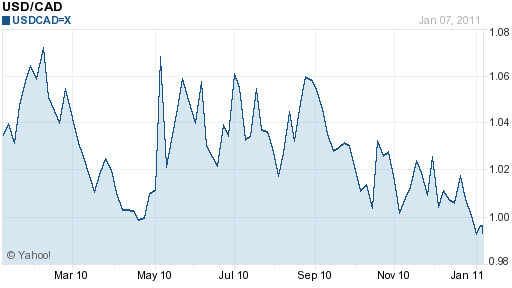
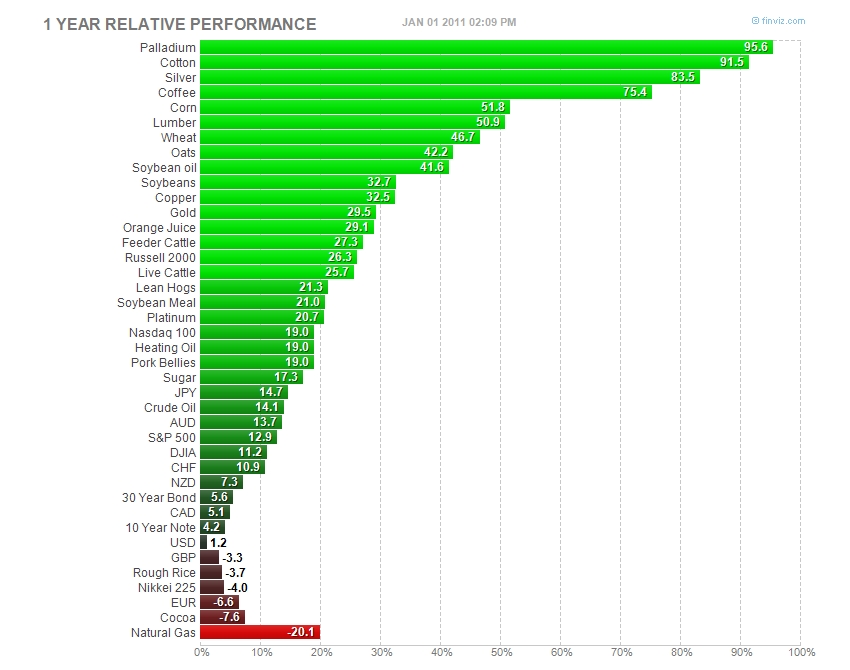
The Canadian Dollar (“Loonie”) recorded a fairly strong 2010. It appreciated 5.5% against the US Dollar, as an encore to a 16% gain in 2009. Moreover, its rise occurred with remarkably little volatility, fluctuating within a tight range of $0.99 – $1.08 (CAD/USD. It total, it rose against “seven of its major peers,” and “gained 4.4 percent over the past year in a measure of 10 developed-nation currencies, Bloomberg Correlation-Weighted Currency Indexes showed.” As for 2011, it is expected to continue trading close to 1:1 against the USD, though analysts differ over which side of parity it will tend towards.

At the moment, there are a few key fundamental trends driving the Loonie. As the WSJ encapsulated, the first factor is investor risk tolerance: “The fortunes of the risk-sensitive Canadian dollar in 2011 will be determined in large part by the issues driving global market fluctuations.”  Due primarily to the EU sovereign debt crisis, risk appetite continues to experience dramatic ebbs and flows. Based on conventional wisdom, risk averse investors should incline towards shunning the Loonie in favor of the US Dollar and other safe haven currencies. However, if you track the Loonie’s actual performance, you can see that concerns over global financial instability have hardly impacted it. Thus, bulls see this uncertainty as a force that “pushes investors to diversify their foreign exchange holdings by picking up some Canadian dollars.”
The second set of factors are macroeconomic. While slowing slightly in the second half of the year, the Canadian economy nonetheless exhibited a solid performance, which is expected to continue into 2011. Goldman Sachs, for example, “now sees growth accelerating to 3.3 per cent in the second quarter of this year, and 3.5 per cent in both the third and fourth quarters amid improving domestic demand.” However, the strong performance by natural resources and Canadian export strength that drove growth in 2010 could also be interpreted as a wild card in 2011, as the trade surplus narrows from a moderation in commodities prices and an expensive Canadian Dollar.
Finally, there is the continuing search for “value currencies” that is driving investors towards the Loonie. According to Bill Gross, manager of the world’s biggest bond fund, “It’s a critical strategy going forward to get…into some currency that holds its value…I’d suggest Mexico, Brazil or Canada as three examples of countries with good fiscal balance sheets.” It doesn’t hurt that the Bank of Canada was the first G7 central bank to raise interest rates, and that its benchmark interest rate compares favorably with the US Dollar, Yen, etc. Moreover, it is forecast to hike rates by an additional 50 basis points in 2011, beginning in the third quarter. On the other hand, it will still be a couple years before rates are high enough to make carry trading viable. Besides, long-term interest rates are currently higher in the US, which means that investors hungry for yield will ultimately have to find other reasons for shifting funds to Canada.
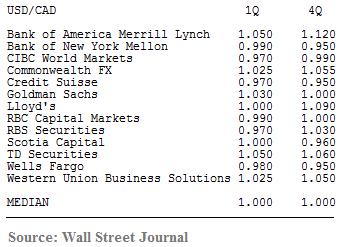
Forecasts for the Canadian Dollar in 2011 are extremely varied. If there’s any consensus, it is that barring any unforeseen developments, the Loonie will spend the year close to parity with the US Dollar. A couple analysts expect a big (downside) move, but the majority expects that regardless of which way the Loonie ultimately trends, it probably won’t be far removed from current levels. “The Bloomberg composite of 32 forecasts has the loonie spending most of the year at parity, then dipping slightly by the fourth quarter.” A similar WSJ survey shows a median forecast of 1:1 throughout the entire year.

Some analysts expect more movement in the currency crosses (i.e. against currencies besides the US Dollar). Given that the Canadian Dollar accounts for such a small portion of overall forex trading volume, however, it seems more likely that CAD cross rates will take their cues entirely from the USD and the rule of triangular arbitrage. (For example, if the Dollar rises against the Loonie but falls against the Aussie in 2011, the Loonie will necessarily also fall against the Aussie, regardless of whether fundamentals dictate such a movie).
I’m personally inclined to agree with the majority. There are many good reasons to buy the Loonie, but most of these were already priced in during the Loonie’s steady climb over the last two years. Going forward, I think that the US economy represents a double-edged sword that will prevent the Loonie from rising further. In short, if the US economy falters, so will the Canadian economy. If the US economic recovery gathers momentum, however, there will be good reason to buy the US Dollar in lieu of its counterpart to the north.